Canada's May Building Permits Soar, Driven by Institutional and Residential Sectors
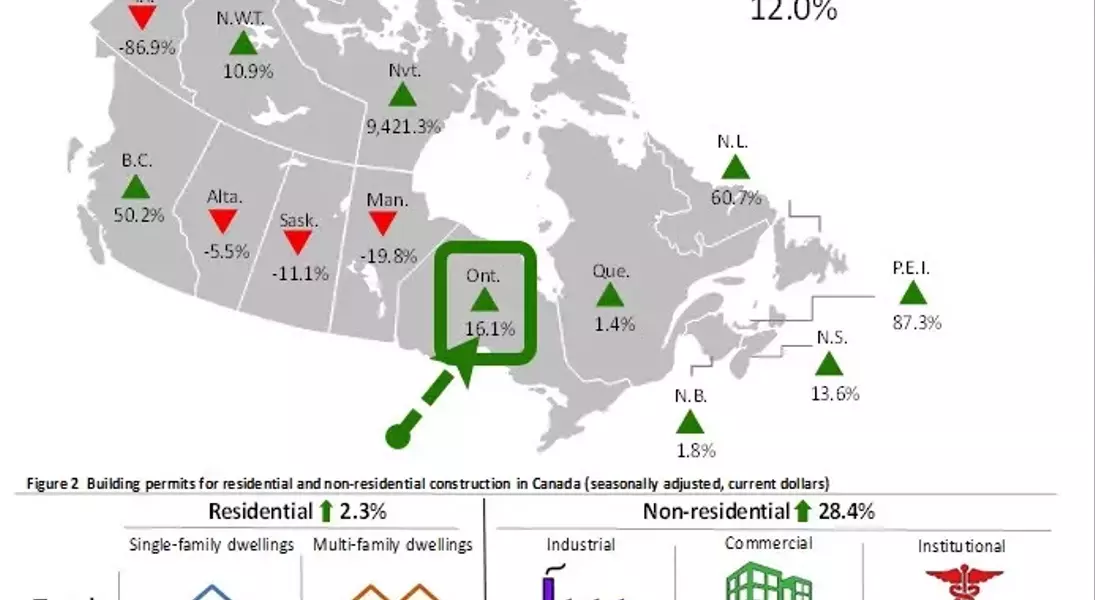
Canada's construction sector experienced an unforeseen boom in May, with building permits dramatically rising by 12.0%, defying expectations of a contraction. This impressive growth was largely propelled by a significant expansion in non-residential construction, notably bolstered by a major institutional project in Ontario. Simultaneously, residential building intentions also saw a healthy increase, particularly driven by multi-family developments in British Columbia. These figures indicate a resilient and unexpectedly robust period for the Canadian building industry, surpassing previous month's declines and market forecasts.
Non-Residential Construction Drives Significant Growth
In May, Canada's non-residential building permits demonstrated a substantial ascent, registering a notable increase of $1.2 billion, propelling the total to $5.6 billion. This significant expansion was predominantly attributed to a surge in Ontario's institutional segment, which alone contributed an additional $1.3 billion to the overall growth. A pivotal element in this surge was the issuance of a new hospital permit within the Niagara Census Metropolitan Area (CMA), valued at nearly seven times the average for major institutional permits.
This single hospital project served as a powerful catalyst, elevating the national institutional component to an unprecedented $2.5 billion, marking a new record. Furthermore, when assessed in constant dollar terms, the institutional sector also achieved a new historical high, underscoring the profound impact of these large-scale investments. Despite the overall positive data, the extraordinary influence of the new hospital permit suggests that while the sector is undeniably strong, a significant portion of this growth is concentrated in specific, large-scale developments.
Residential Building Intentions Show Resilience
Residential construction intentions across Canada observed a positive trajectory in May, with an increase of $169.8 million, bringing the total value to $7.5 billion. This forward momentum was predominantly ignited by the robust performance of British Columbia's multi-family housing component, signifying a healthy demand and ongoing development in higher-density living spaces.
The multi-family permits in British Columbia experienced a considerable boost, escalating by $687.7 million to reach $1.5 billion. This substantial rise indicates a vigorous construction market for multi-unit dwellings in the province, contributing significantly to the national residential permit figures. The overall strength in residential intentions, particularly in the multi-family sector, suggests that despite broader economic conditions, the housing market continues to see active planning and investment, meeting evolving housing needs and population growth.