Currency Market Realigns After Political Speculation
Recent speculation regarding the leadership of the Federal Reserve triggered considerable turbulence across global currency markets. The US dollar, in particular, underwent sharp swings as unsubstantiated reports surfaced about the possible removal of the central bank's chairman. This led to immediate and pronounced shifts in the valuations of major currency pairs against the greenback, prompting market participants to closely monitor key technical indicators for signs of stabilization and directional bias.
The trading day for the US dollar commenced with an upward trajectory during the American session, building on the previous day's gains. However, this positive momentum was abruptly interrupted by unverified news circulating about the potential dismissal of Federal Reserve Chair Jerome Powell. This rumor sent shockwaves through the market, causing an immediate and sharp depreciation of the dollar against all major currencies. The market's reaction underscored the profound influence of political developments on financial stability, particularly concerning the independence and leadership of the central bank.
As quickly as the dollar fell, it rebounded with equal force. The subsequent denial of the firing rumors by the former President reversed the dollar's trajectory, sending it sharply higher once again. This whipsaw action left the dollar trading near the mid-point of its daily range, reflecting the intense uncertainty and rapid adjustments made by market participants. This period of extreme volatility highlighted the sensitivity of foreign exchange markets to high-profile political commentary and the immediate need for clarity on such matters.
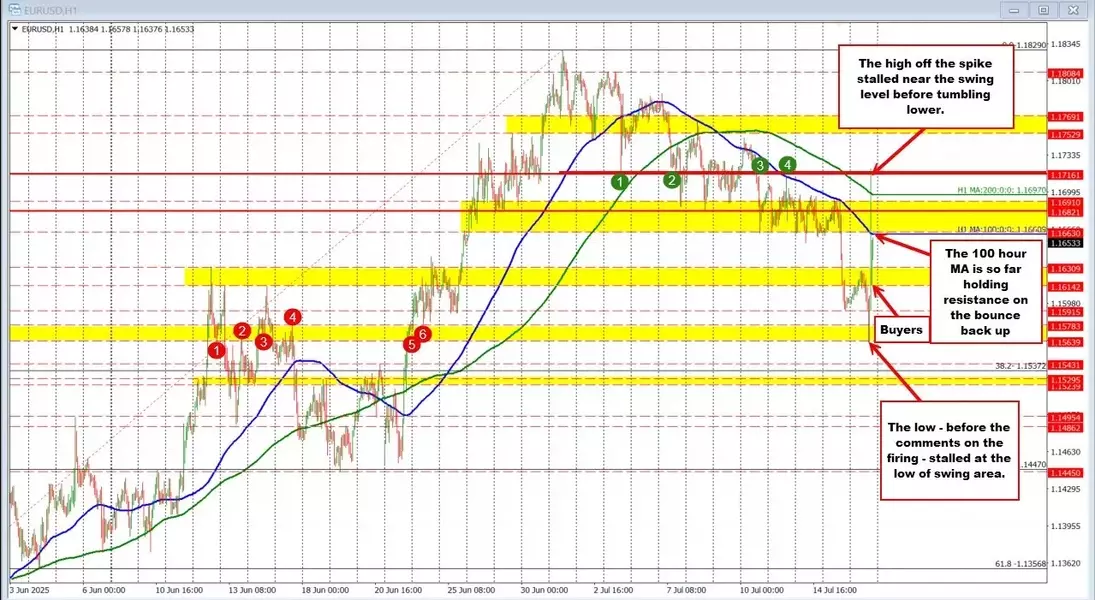
In the aftermath of this dramatic interlude, the euro experienced a significant surge against the dollar. The EURUSD pair breached several critical technical resistance levels, including the 100-hour moving average at 1.1661 and a historically significant swing area between 1.1663 and 1.1691. This upward movement briefly pushed the pair above the 200-hour moving average at 1.1697, reaching a peak of 1.17208. However, the subsequent retraction of the rumors led to a swift reversal, with the EURUSD falling back to 1.1614, the lower bound of another crucial support zone. Despite the temporary rally, short-term sellers have largely maintained control, as the pair remains beneath the 100-hour moving average.
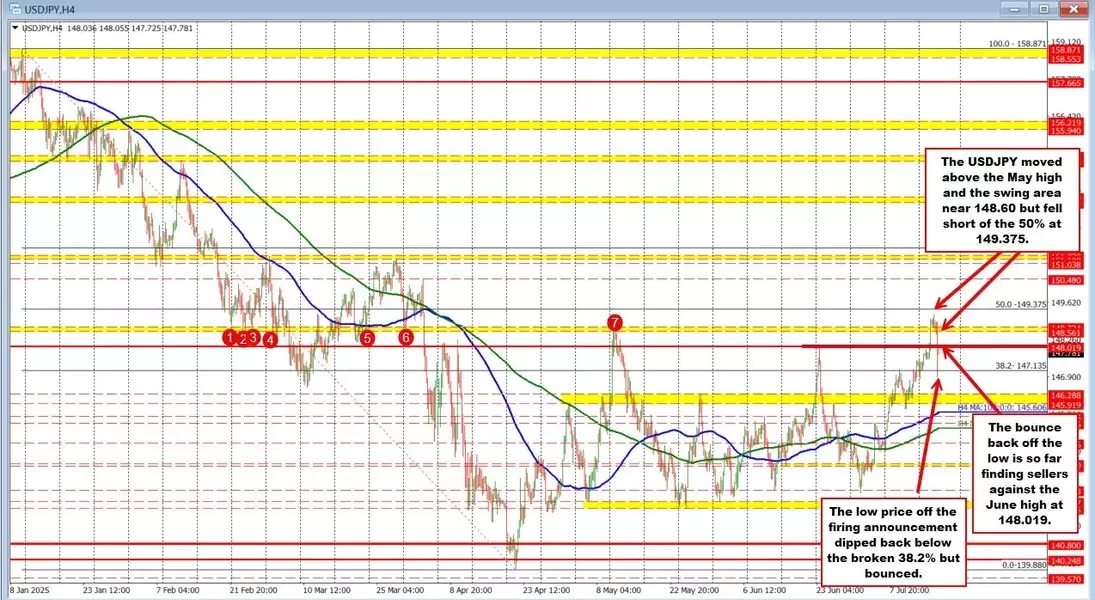
To regain a bullish stance, the EURUSD would need to decisively break above the 100-hour moving average at 1.1661, clear the 1.1691 resistance, and push beyond the 200-hour moving average at 1.1697. Conversely, a sustained break below 1.1614 would amplify selling pressure, directing focus toward lower support levels. Meanwhile, the USDJPY pair initially traded above a key swing area between 148.56 and 148.72. The firing speculation caused a sharp decline, pushing the pair below the June high of 148.012 and the 38.2% Fibonacci retracement level at 147.135. Following the denial, the pair recovered but has largely settled below the 148.019 mark. A continued decline below this level or a breach of the 38.2% retracement would indicate a renewed bearish bias. Conversely, a sustained move above 148.019 would restore confidence among buyers.
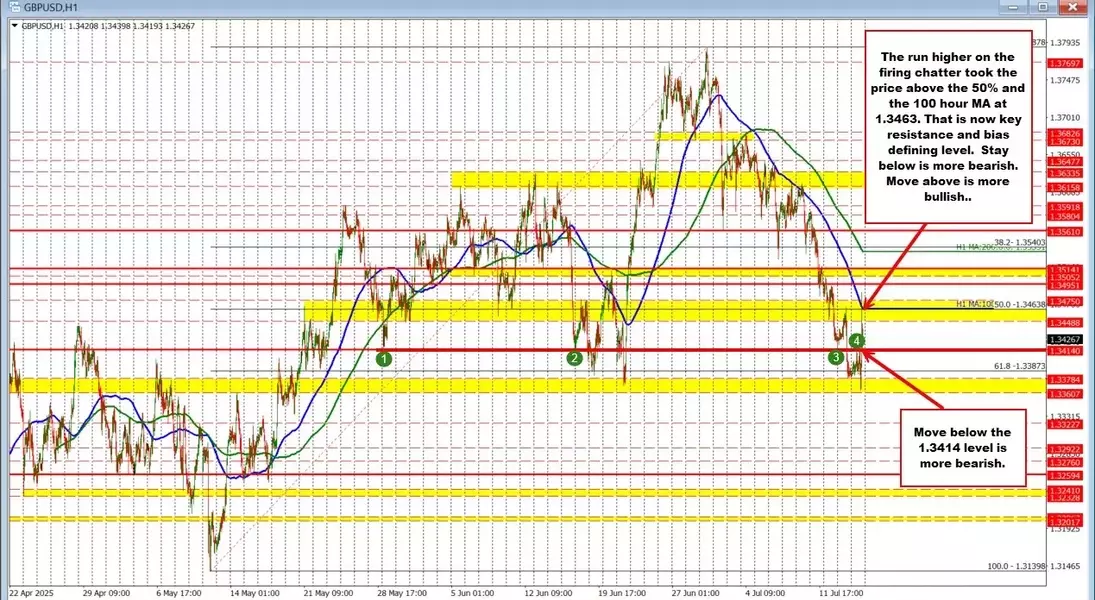
For the GBPUSD, the early US trading session saw the pair entering a swing area between 1.33607 and 1.3378. The initial reports of Powell's potential ousting caused a sharp upward spike, breaking above both the 100-hour moving average and the 50% midpoint of the May low's range, both converging at 1.34638. Nevertheless, this upward momentum was short-lived, as the clarification of the rumors led to a reversal. The pair found support near 1.3414, with buyers attempting to defend this level. A drop below 1.3414 would expose the 61.8% retracement at 1.3387, followed by a retest of the 1.33607 swing zone. Holding above 1.3414 keeps the focus on the 1.34638 resistance; a sustained break above this point would signal a more bullish short-term outlook.
The currency markets are currently navigating a complex landscape shaped by rapid news cycles and shifting political narratives. While the immediate shock from the Federal Reserve Chairman's speculation has subsided, market participants remain vigilant, closely monitoring technical thresholds to gauge the stability and future direction of major currency pairs. The recent events underscore the inherent interconnectedness of political rhetoric and financial market behavior, especially in an environment where information spreads instantaneously.