Euro's Decline Continues as US-EU Trade Deal Sparks Discontent
The currency markets are currently witnessing a notable downturn in the Euro's value against the US Dollar, a trend primarily influenced by the repercussions of a recently concluded trade agreement between the United States and the European Union. Despite an initial sigh of relief among some market participants, the agreement has drawn significant criticism from European legislators, who contend that its terms fall short of expectations. This ongoing dissatisfaction is casting a shadow over the Euro's performance, pushing it towards critical support thresholds. Simultaneously, a resurgent US Dollar is exerting additional downward pressure across the foreign exchange landscape, indicating a broader shift in investor sentiment.
Euro's Retreat Deepens Amidst Post-Deal Disillusionment
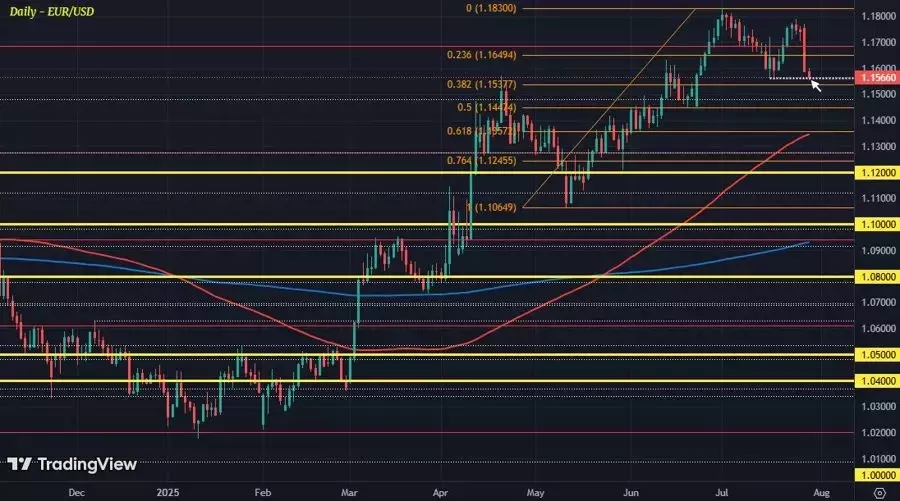
In recent trading, the Euro has demonstrably weakened against the US Dollar, registering a daily decline of approximately 0.2%. This movement has driven the EUR/USD pair to touch a momentary low of 1.1555, a level not observed since late June. The initial market reaction to the US-EU trade accord was characterized by a collective exhalation, as observers believed the most severe outcomes had been successfully averted. This sentiment briefly offered a reprieve to the common currency. However, as the immediate euphoria dissipated, a wave of discontent has begun to spread among European policymakers. Numerous prominent figures in the European legislative bodies are openly voicing their disapproval, branding the recently forged agreement as inadequate.
Technical analysis reveals that the Euro's current trajectory is being somewhat contained by the July low zone, specifically within the 1.1560-72 range. Nevertheless, the persistent selling pressure on the Euro suggests that a breach below this significant support area is increasingly probable. Should this level be decisively broken, the path could open for the EUR/USD pair to test the 1.1500 psychological barrier. Beyond this, a more substantial decline could see the pair gravitating towards the 38.2% Fibonacci retracement level at 1.1537, or even the more critical 50.0% Fibonacci retracement level situated at 1.1447, which represents a key point from the recent upward swing since May. This downward momentum in the Euro is exacerbated by the broader strength of the US Dollar, which is also impacting other major currency pairs. For instance, the British Pound (GBP/USD) has fallen by 0.2% to 1.3330, and the Australian Dollar (AUD/USD) has seen a 0.1% decrease to 0.6513. In contrast, the Japanese Yen (USD/JPY) has experienced a slight dip of 0.1%, trading at 148.35.
From an observer's perspective, this unfolding scenario underscores the intricate interplay between geopolitical developments and currency valuations. The immediate market response to an event, such as a trade deal, can often be driven by a simplistic 'avoided disaster' narrative. However, as the finer details emerge and political ramifications become clearer, the true long-term impact on asset prices, particularly currencies, begins to manifest. The current situation highlights the crucial role of internal political consensus and stakeholder acceptance in the sustained success of international agreements. Furthermore, it serves as a stark reminder that in the volatile world of foreign exchange, broader market trends, such as the overall strength of a reserve currency like the US Dollar, can significantly amplify or mitigate the effects of specific regional developments.