European Equities Stumble, Spain's IBEX Underperforms Amid Global Market Downturn
European stock markets concluded trading with widespread declines, as leading indices across the continent registered losses. Notably, the Spanish IBEX index recorded the most substantial fall, reflecting a particularly challenging day for its equities. This downward trend was not confined to Europe, as U.S. markets also shifted into negative territory, indicating a broader environment of investor caution. The synchronized decline underscores a period of uncertainty impacting global financial landscapes.
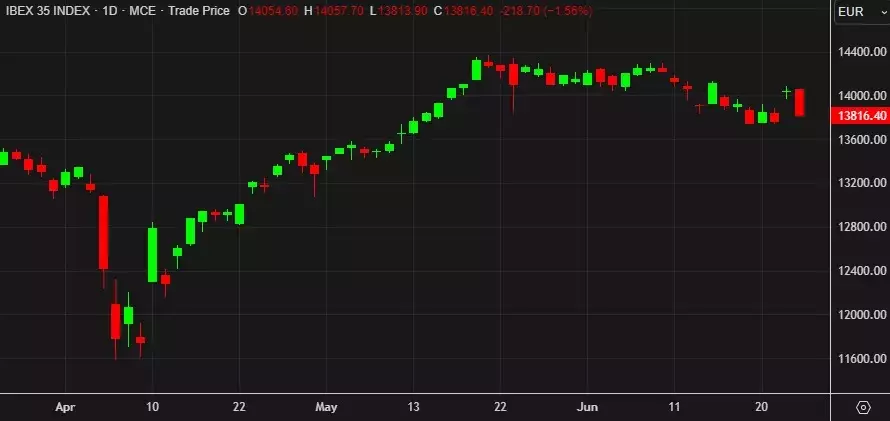
The day's trading saw prominent European benchmarks like Germany's DAX, France's CAC, and the UK's FTSE 100 all close in the red. These movements suggest a collective retreat by investors from risk assets, possibly influenced by a confluence of geopolitical and economic factors. The pronounced underperformance of Spain's market highlights specific pressures or concerns weighing on its domestic economy and investment outlook.
European Markets Retreat, Spain's Index Leads Declines
European stock markets wrapped up the trading session with notable contractions across key indices. Germany's DAX, representing a major economic powerhouse in the Eurozone, saw a reduction of 0.6%. Similarly, France's CAC, another vital indicator of the continent's economic health, experienced a 0.7% downturn. The United Kingdom's FTSE 100, a bellwether for British financial performance, also recorded a decrease of 0.4%. However, the most significant decline was observed in Spain's Ibex, which plunged by 1.5%, marking it as the weakest performer among its European counterparts. This widespread negative sentiment in European equities suggests a collective response to prevailing market uncertainties or economic headwinds affecting the region.
The market's performance underscores a cautious atmosphere among investors, leading to a broad sell-off across various European bourses. The pronounced dip in Spain's IBEX warrants closer examination, potentially pointing to specific domestic concerns or heightened investor sensitivity towards the Spanish economy. This decline is part of a larger narrative of market reassessment, as global economic conditions continue to evolve. The interconnectedness of financial markets means that challenges in one major economy can quickly ripple through others, leading to a synchronized negative reaction. Investors are likely repositioning portfolios in anticipation of further developments, impacting asset valuations and liquidity across the board.
Global Market Interconnectedness: US Follows European Downturn
The pessimistic mood pervasive in European equity markets swiftly migrated across the Atlantic, with U.S. stock markets also beginning to dip into negative territory. This simultaneous decline in major global markets signifies a broader, interconnected response to underlying economic or geopolitical pressures. The absence of specific catalysts in the immediate news flow suggests that investor sentiment might be driven by cumulative concerns, perhaps linked to inflation, interest rate expectations, or unresolved international disputes. The mirroring of trends across continents highlights the integrated nature of today's financial system, where regional market dynamics can quickly become global phenomena.
The synchronized movements between European and U.S. markets reinforce the notion that investors are reacting to shared anxieties. This confluence of market trends serves as a reminder of the delicate balance within the global financial ecosystem. When such significant markets experience concurrent downturns, it often implies a pervasive risk-off attitude, leading to capital reallocation from equities to safer assets. The current scenario suggests that the factors driving down European stocks are not isolated but are part of a larger set of concerns that resonate with investors worldwide, compelling them to adopt a more conservative stance. This global market synchronization underscores the importance of a holistic view when assessing financial health and predicting future movements.