Hassett's Economic Insights: Trade Deals, Tariffs, and the US Economy
This comprehensive analysis delves into the United States' current economic landscape, focusing on trade policies, the impact of tariffs, and the intricate relationship between government objectives and central bank autonomy. It illuminates the administration's strategic approach to international commerce, particularly its efforts to secure advantageous trade agreements and address perceived national emergencies related to trade imbalances and cross-border issues. Furthermore, the report examines the unexpected deflationary effect of tariffs on import prices, suggesting a underlying surge in national pride driving consumer behavior. Finally, it touches upon the crucial role of the Federal Reserve's independence, even in the face of differing economic forecasts, and the potential for increased domestic manufacturing to stabilize consumer prices.
Detailed Economic Commentary by Kevin Hassett
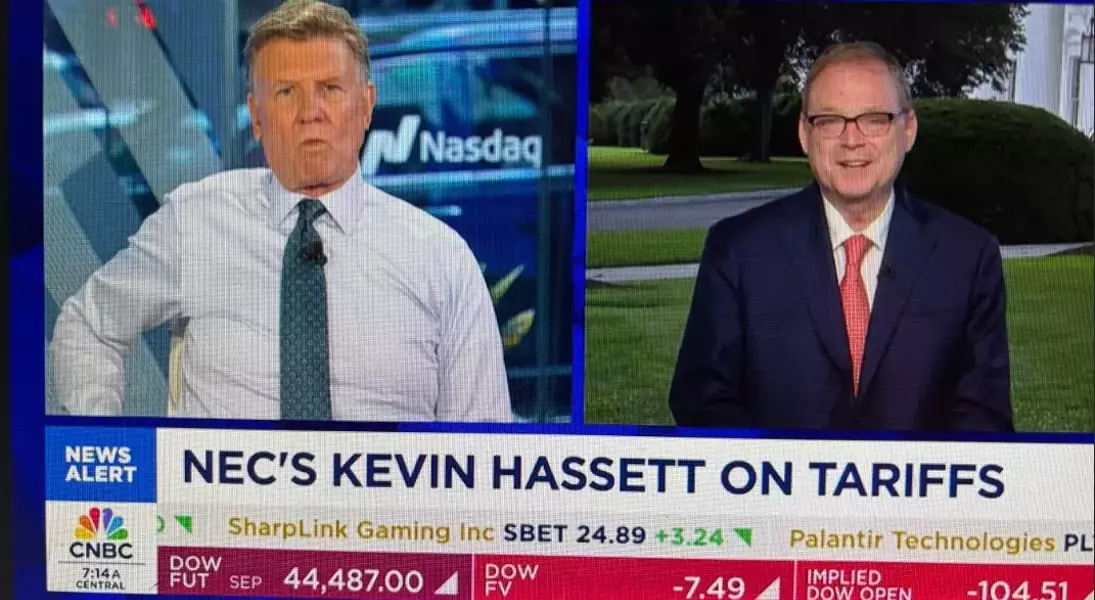
On a bright Monday, July 14, 2025, economist Kevin Hassett offered insightful commentary on the current administration's economic perspectives during an appearance on CNBC. He meticulously articulated the ongoing progression of trade negotiations, reaffirming that the President's paramount focus remains on securing the most advantageous outcomes for the nation.
Hassett presented an intriguing observation regarding the current economic climate: import prices into the United States are unexpectedly declining, even amidst the implementation of tariffs. He posited that this phenomenon is partly attributable to a burgeoning sense of patriotism among American consumers, who are increasingly recognizing the superior quality of domestically produced goods and, in turn, bolstering local communities through their purchasing choices. He suggested that this palpable surge in national sentiment is actively contributing to the downward pressure on import costs.
Furthermore, Hassett highlighted critical areas the administration considers national emergencies, necessitating robust policy responses. These include the persistent challenge of illicit drug trafficking from Mexico, which he views as a justification for the application of tariffs. He also pointed to substantial trade deficits, specifically mentioning the European Union's surplus with the United States, as another pressing concern. In a notable instance, he cited Brazil's alleged transshipment of Chinese goods, classifying it as an additional "national emergency" requiring intervention.
Touching upon monetary policy, Hassett firmly asserted the vital importance of the Federal Reserve's autonomy. Despite this, he critically noted that the Federal Reserve has, in his view, significantly misjudged the inflationary impact of tariffs. He concluded his remarks by forecasting that as domestic production within the United States expands, the prevailing price pressures are likely to recede, fostering greater economic stability. He also commented on the unusual divergence in the correlation between European and US interest rates, indicating a potential misalignment in global financial indicators.
From a journalistic perspective, Hassett's statements underscore a fascinating dynamic where economic policy is deeply intertwined with broader geopolitical and societal considerations. His emphasis on patriotism as an economic driver offers a unique lens through which to view consumer behavior and market forces. The assertion of 'national emergencies' in trade further signals an aggressive stance that could reshape international trade relations. However, the tension between the administration's interventionist trade policies and the Federal Reserve's mandate for independence presents a complex challenge. It prompts us to consider how these disparate approaches will ultimately converge or diverge, and what long-term implications this will have for global economic stability and domestic prosperity. It is clear that the path ahead involves navigating a delicate balance between national interest and global economic realities.