Japan's June Producer Price Index: A Detailed Analysis
Japan's wholesale price landscape in June presented a picture of stabilization, with the Producer Price Index (PPI) demonstrating growth that met anticipated levels. While the annual increase maintained a steady pace, the slight monthly contraction offers a nuanced perspective on the nation's corporate goods pricing. This crucial economic metric, which gauges the average change over time in the selling prices received by domestic producers for their output, provides a foundational understanding of inflationary pressures from the supply side, influencing everything from manufacturing costs to consumer prices.
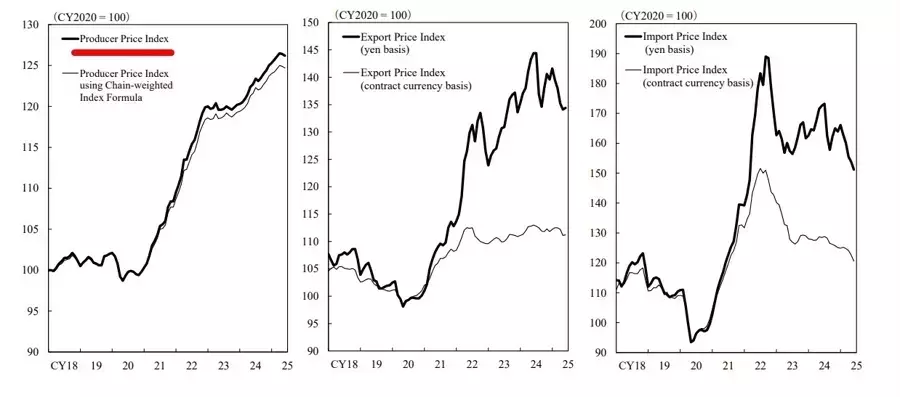
Japan's June Producer Prices Reveal Stable Growth Amidst Monthly Dip
In the bustling economic heart of Japan, the month of June 2025 unveiled the latest figures for the nation's Producer Price Index (PPI), a key barometer of wholesale price trends. The data indicated a year-over-year increment of 2.9%, precisely mirroring the consensus expectations of market analysts. This annual rise, while robust, marked a subtle slowdown from May's revised 3.2% increase, suggesting a slight moderation in the pace of inflationary pressures at the producer level.
Delving into the month-over-month performance, the PPI experienced a marginal contraction of 0.2%, aligning perfectly with expert forecasts. This minor dip, following a similar 0.2% decline in the preceding month, points towards a stable, albeit slightly recessive, trend in the immediate pricing dynamics among Japanese corporations. The Corporate Goods Price Index, as it is formally known, meticulously tracks the prices at which businesses transact goods and services amongst themselves, offering a prelude to potential shifts in consumer inflation.
These figures, released in the early hours of Wednesday, July 9, 2025, at 23:52 GMT, emanate from the Bank of Japan, the central institution responsible for compiling and disseminating such vital economic statistics. The data provides a contemporaneous snapshot of the economic environment, enabling policymakers and market participants to assess the underlying health of the industrial sector and its capacity to absorb or pass on costs.
Reflections on Japan's Economic Data: A Balancing Act
The latest PPI data from Japan serves as a compelling reminder of the intricate balance within a modern economy. On one hand, the consistent year-over-year growth, even with a slight deceleration, underscores the persistent inflationary pressures that have been a global theme. For businesses, this means navigating an environment where input costs continue to rise, albeit at a slightly less aggressive pace. This necessitates strategic adjustments in pricing, production, and supply chain management to maintain profitability and competitiveness.
On the other hand, the month-on-month decline, consistent with expectations, offers a glimmer of stability. It suggests that while annual inflation remains a factor, the immediate pricing landscape might be entering a phase of consolidation or minor deflation. As a reporter, I find this particularly intriguing because it highlights the dynamic nature of economic indicators. A simple percentage point can tell a story of careful navigation by both producers and the central bank. It prompts questions about the sustainability of current growth rates and the potential for a shift in monetary policy. For the average reader, understanding these nuances is crucial, as wholesale price changes can ripple through the economy, eventually impacting the prices of everyday goods and services. It's a continuous economic narrative, where each data release adds another chapter to the ongoing story of global financial health.