Rivian's Growth Trajectory: Lessons from Tesla and Future Prospects
Rivian, an electric vehicle manufacturer, has demonstrated remarkable growth since its initial public offering in 2021, transitioning from negligible revenue to an annual figure exceeding $5 billion. This impressive ascent positions Rivian as a compelling, yet arguably undervalued, player in the electric vehicle sector. The company's future trajectory is set to mirror the successful scaling strategies employed by industry leader Tesla, particularly as Rivian prepares to introduce more accessible models to a wider consumer base.
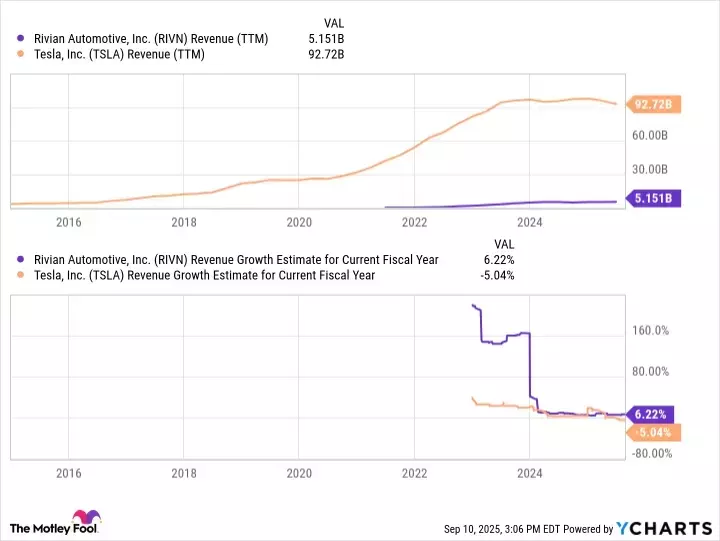

Understanding Rivian's potential requires an examination of Tesla's historical growth. Tesla's dominance in the EV market is largely attributed to its ability to mass-produce electric vehicles at competitive prices. This endeavor necessitated substantial capital investment and the development of extensive infrastructure, a process spanning over a decade. Tesla's growth initially stagnated before accelerating significantly with the introduction of its mass-market vehicles, the Model 3 and Model Y, in 2017 and 2020 respectively. This demonstrates a critical pathway for EV manufacturers to achieve widespread adoption and substantial revenue increases.
Rivian is on the cusp of a similar transformation. The anticipated launch of its more affordable R2 model, projected to be priced around $45,000, is a pivotal moment for the company. Following the R2, Rivian plans to roll out the R3 and R3X, further expanding its reach into the mass market. This strategic move is expected to reignite revenue growth, with analysts forecasting over 30% increase for Rivian next year, echoing the post-mass-market-launch success of Tesla. The expansion of its accessible vehicle lineup will be instrumental in driving higher sales volumes and enhancing operational efficiency.
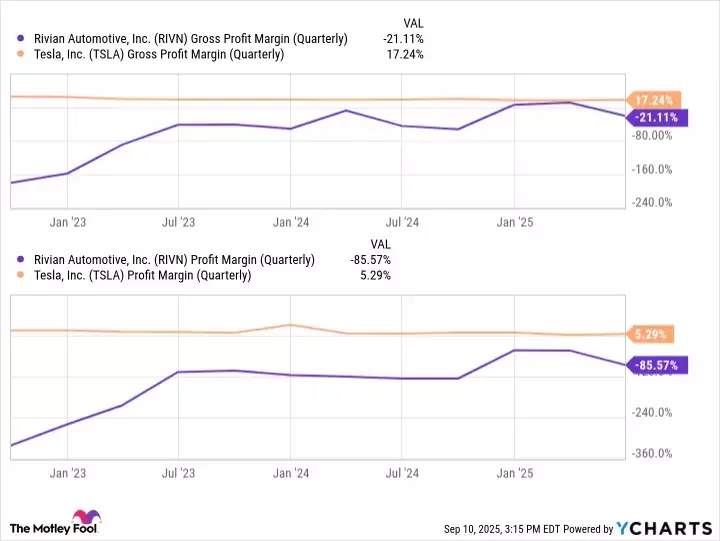
Beyond revenue, Rivian's gross and profit margins are expected to see significant improvements, particularly in 2026, as production of the R2 model scales up. Tesla's sustained profitability, largely driven by its high-volume Model 3 and Model Y sales, highlights the importance of achieving economies of scale. For Rivian, the success of the R2, R3, and R3X models is crucial for gaining operational leverage and boosting overall profitability. However, the company faces potential headwinds, including the recent elimination of federal tax credits and incentives for EVs, which could impact consumer demand. Additionally, changes in legislation that remove penalties for automakers producing less fuel-efficient vehicles and reduce the value of automotive credits could affect Rivian's financial performance. Despite these challenges, Rivian's current valuation, trading at less than three times sales, suggests that the market may be underestimating its long-term growth potential, drawing a clear parallel to Tesla's meteoric rise. Investors anticipating Rivian's evolution into a major player in the electric vehicle industry should consider the company's current positioning and its strategic roadmap for mass-market penetration.