US Dollar's Stagnation Amidst Shifting Trade Dynamics and Market Uncertainties
The financial markets observed a relatively calm session on Wednesday, marked by the US dollar's steady performance. However, underlying currents of trade policy shifts and nuanced monetary discussions hinted at potential volatility. A significant intraday decline in the USD/JPY pair, coupled with falling US Treasury yields, highlighted the sensitivity of currency markets to these factors. The equity market's resilience, particularly in technology and industrial sectors, demonstrated a decoupling from traditional economic signals, while ongoing debates within the Federal Reserve regarding interest rate adjustments further underscored the complex economic landscape. The recent imposition of tariffs on Brazil by the US signals a more assertive trade stance, which could have far-reaching implications for global commerce and currency valuations.
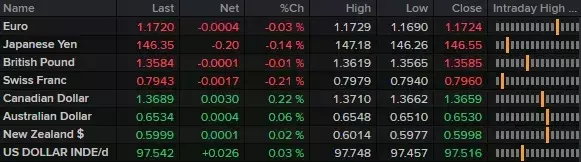
Amidst these developments, the dollar's performance and the broader market's direction remain subject to the evolving narrative of international trade and central bank policy. The aggressive tariff approach adopted by the US administration, characterized by its immediate and potentially disruptive nature, may compel trading partners to re-evaluate their strategies. This shift could lead to a significant reassessment of the US dollar's position in the global financial system, especially if trade tensions escalate. Investors are therefore closely monitoring these geopolitical and economic shifts, along with indicators like Bitcoin's movement, for insights into market sentiment and future trends.
The Shifting Sands of Trade Policy and Dollar Stability
The global financial landscape on Wednesday witnessed the US dollar holding its ground, though not without underlying tensions, as attention pivoted towards the unpredictable realm of international trade policy. A notable development was the mid-day reversal in the USD/JPY pair, which saw its value drop after reaching a two-week high, mirroring a similar decline in US Treasury yields. This fluctuation served as a stark reminder of how interconnected currency valuations are with bond market dynamics. Concurrently, the stock market seemed to operate independently of traditional macroeconomic forces, drawing considerable strength from leading tech companies, particularly Nvidia, and robust industrial sector gains. This divergence suggested that investor confidence was being buoyed more by sector-specific growth stories than by broader economic fundamentals. Meanwhile, internal discussions within the Federal Reserve indicated a divided stance on future interest rate cuts, with some officials expressing caution, highlighting the persistent uncertainty surrounding monetary policy and its potential impact on market stability.
The dollar's surprising resilience in July, despite recent indications of vulnerability, underscored its complex reaction to global events. The decision by the US administration to levy new tariffs on Brazil, even with Brazil's trade deficit with the US, exemplifies a reactive and often aggressive approach to trade relations. This action suggests a foreign policy rooted in immediate, retaliatory measures rather than reciprocal agreements, signaling a potentially turbulent era for international commerce. Such an approach might eventually lead trading partners to conclude that traditional negotiations are ineffective, prompting them to adopt different strategies in response. This strategic re-evaluation by global trade partners could, in turn, trigger a significant re-pricing of the US dollar, especially if the current administration's confrontational trade policies intensify. Therefore, the trajectory of the dollar and broader market sentiment will largely depend on how these trade dynamics evolve and whether geopolitical tensions can be mitigated.
Monetary Policy Crossroads and Market Resilience
The Federal Reserve's recent deliberations brought to light a divergence of opinions among its members regarding the timing and necessity of interest rate adjustments. While a few participants expressed openness to a July rate reduction, the consensus leaned towards a more cautious approach, with some officials concerned that market exuberance, especially in the stock market, might dampen the urgency for such cuts. This internal debate within the Fed signals a complex decision-making process, balancing inflationary pressures against economic growth and market stability. The stock market's continued upward trajectory, propelled by the artificial intelligence boom and strong industrial performance, further complicates the Fed's calculus, as a buoyant market might paradoxically reduce the perceived need for immediate monetary easing.
Looking ahead, the performance of the US dollar remains a critical indicator of market sentiment, especially in light of escalating trade tensions. The dollar's slight softening, following a period of considerable strength earlier in the month, suggests that the market is beginning to price in the potential ramifications of the new tariff policies. Investors are keenly observing how these protectionist measures will impact international trade flows and, consequently, the dollar's valuation. Beyond traditional currency analysis, the cryptocurrency market, particularly Bitcoin, is also being closely watched for signals of broader risk appetite. Bitcoin's recent attempt to breach the $112,000 mark before retreating indicates a volatile yet influential asset that reflects rapid shifts in investor confidence. The interplay between trade policy, central bank actions, and speculative markets will undoubtedly shape the economic narrative in the coming days, demanding careful consideration from all market participants.