US Retail Sales Exceed Expectations in June, Indicating Robust Consumer Spending
The United States' retail sector experienced an unexpectedly strong performance in June, with sales figures considerably outstripping forecasts. This positive trend was largely driven by robust consumer spending across several key categories, although some minor weaknesses were observed in specific segments. The data provides a compelling snapshot of current economic resilience, particularly as it relates to the components that directly feed into the nation's Gross Domestic Product calculations.
Detailed Analysis of June 2025 US Retail Sales Performance
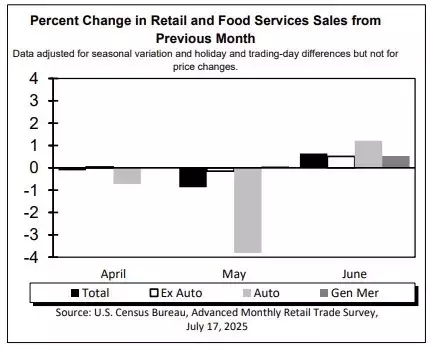
On a bright Thursday, the 17th of July, 2025, at 12:30 GMT, the latest reports from the United States revealed a significant uplift in retail sales for June. The overall increase stood at an impressive 0.6% month-over-month, starkly contrasting with the mere 0.1% growth economists had projected. This surge followed a revised decline of 0.9% in the preceding month, signaling a strong rebound in consumer activity.
Breaking down the numbers, retail sales, excluding the volatile auto sector, climbed by 0.5%, surpassing the 0.3% estimate. The prior month's figure for this category was also favorably revised to a modest 0.2% decrease from an initial 0.3% decline. When excluding both gasoline and auto sales, the growth remained robust at 0.6%, a significant improvement from the previous month's 0.1% contraction, which was also revised from an initial 0.1% negative to a flat 0.0%.
A crucial indicator for understanding core consumption trends, the retail sales control group, which directly feeds into GDP calculations, registered a 0.5% increase, outperforming the 0.3% forecast. However, it is noteworthy that the prior month's control group figure was adjusted downwards to 0.2% from an initial 0.4%, adding a layer of nuance to the otherwise positive outlook. On a year-over-year basis, retail sales advanced by 3.5%, a slight acceleration from the 3.29% recorded in the previous month.
While the overall picture is encouraging, it's essential to remember that these retail sales figures are not adjusted for inflation. This introduces some ambiguity, particularly in categories like clothing, which saw a 0.9% rise, and furniture and home furnishings, up by 0.7%, where higher prices due to tariffs could be a contributing factor rather than purely increased volume of goods sold. Conversely, electronics and department stores experienced slight declines, highlighting varied performances across the retail landscape.
Key sectors driving the June growth included non-store retailers (e-commerce), which saw a 1.2% rise to $122.813 billion, building materials and garden supply stores with a 0.9% increase to $40.120 billion, motor vehicle and parts dealers up 0.9% to $138.053 billion, and clothing and clothing accessories gaining 0.9% to $26.342 billion. General merchandise stores also posted a 0.7% increase to $77.250 billion, alongside furniture and home furnishings, up 0.7% to $11.543 billion, and food and beverage stores, which grew by 0.6% to $84.322 billion.
On the other hand, a few segments experienced mild contractions. Health and personal care stores dipped by 0.5% to $38.843 billion, electronics and appliance stores saw a 0.3% decline to $7.626 billion, and department stores, a subset of general merchandise, fell by 0.8% to $3.202 billion. Gasoline stations remained largely flat, with a marginal 0.02% decrease to $50.291 billion.
In essence, June's retail sales report paints a predominantly optimistic picture, with strong gains in crucial sectors underpinning consumer spending and supporting economic expansion, despite minor downturns in select areas.
From a journalist's perspective, these latest retail sales figures for June 2025 offer a compelling narrative about the resilience and adaptability of the American consumer and the broader economy. The significant beat over estimates, especially in the control group, underscores a vibrant consumer demand that continues to defy some lingering economic uncertainties. This data serves as a critical indicator for policymakers and investors alike, suggesting that the foundations of economic growth remain robust, perhaps even stronger than generally perceived. However, the caveat regarding inflation's impact on nominal sales figures reminds us that while the numbers are up, the true volume of goods consumed may warrant closer scrutiny. It’s a testament to the dynamic nature of economic cycles, where consumer confidence, even amidst external pressures like tariffs, can significantly sway market outcomes and provide a much-needed boost to the national income. This report encourages a cautiously optimistic outlook, prompting further inquiry into the sustainability of this spending spree and its implications for future monetary policy decisions.