US Stock Market: Quiet Trading Session with Russell 2000 Leading Rebound
Navigating the Narrow Channel: Market Dynamics and Emerging Trends
A Day of Subdued Movement Across Major US Stock Indices
On the most recent trading day, the performance of leading North American equity markets was largely characterized by minimal fluctuations, indicating a period of restrained activity. The S&P 500, a broad market indicator, registered a marginal decline of 0.1%, reflecting a generally flat sentiment across large-cap stocks. Similarly, the Nasdaq Composite, heavily weighted towards technology shares, concluded the session virtually unchanged, underscoring a lack of significant directional impetus in the tech sector. The Dow Jones Industrial Average, comprising 30 prominent American companies, also experienced a slight retreat, ending down by 0.4%. Meanwhile, north of the border, Canada's Toronto TSX Composite index mirrored this trend, closing with a 0.5% decrease, suggesting a synchronized cautious approach across both markets.
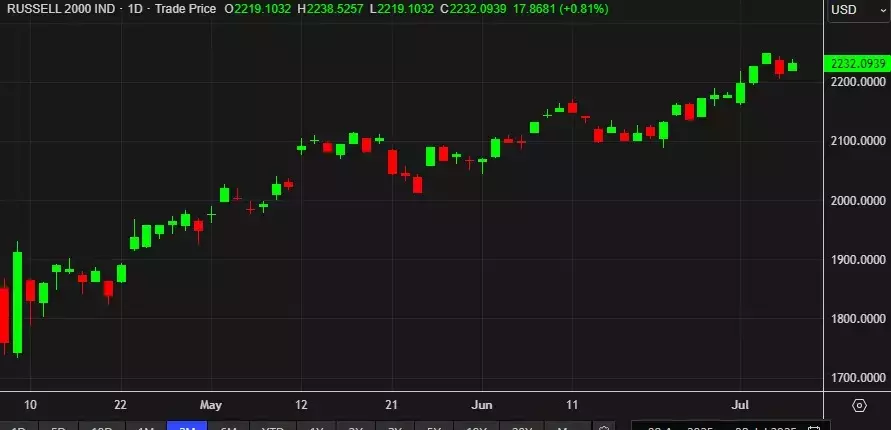
Russell 2000's Resilience Amidst Market Quietude and Tariff Concerns
In a notable divergence from its larger counterparts, the Russell 2000 index, which tracks the performance of small-cap companies, demonstrated commendable resilience. It posted a healthy gain of 0.7%, effectively recouping ground lost in the previous session's sharp sell-off. This recovery is particularly significant given the recent concerns surrounding tariff announcements, which had negatively impacted market sentiment. The rebound in the Russell 2000 suggests renewed investor confidence in smaller enterprises, potentially signaling a shift in focus towards segments of the market perceived as undervalued or offering higher growth potential. This performance provides a glimmer of optimism amidst an otherwise placid market landscape, highlighting the diverse responses of different market segments to prevailing economic and policy narratives.
Spotlight on Sectoral Performance and Individual Stock Movers
During the session, certain sectors and individual equities stood out with their distinct performances. Among the top gainers, Moderna surged by 9%, and Intel saw a strong 7% increase, reflecting positive investor sentiment towards the pharmaceutical and semiconductor industries, respectively. Oil-related stocks also experienced an uplift, capitalizing on favorable energy market conditions. Conversely, several prominent companies acted as drag factors on the market. Nike, JPMorgan, and Walmart were among the laggards, indicating challenges or profit-taking in the consumer goods, financial, and retail sectors. The underperformance of financials, in particular, might suggest that investors are beginning to lock in profits ahead of the upcoming second-quarter earnings reports, signaling a cautious stance in anticipation of new financial data. Furthermore, gold mining companies faced a difficult day, experiencing significant declines, possibly due to shifting commodity prices or broader market risk appetites.
The Reemergence of 'Meme Stocks' and Broader Market Implications
An intriguing development observed in the wider market context is the renewed activity and leadership shown by 'meme stocks'—shares that gain popularity through social media and online forums, often driven by speculative trading. While their resurgence can indicate heightened investor enthusiasm and liquidity, it is also viewed by some market observers as a potential warning sign. The leading performance of these highly speculative assets might suggest that the market is entering a mature phase, colloquially referred to as the 'latter innings' of a market cycle. Historically, such periods can be characterized by increased risk-taking and irrational exuberance, potentially preceding a market correction. However, as past cycles have shown, speculative rallies can extend for considerable durations, making it challenging to precisely time market tops or predict immediate reversals based solely on this indicator.