USD/JPY Exchange Rate Experiences Modest Recovery Amidst Quiet Markets
The USD/JPY currency pair has exhibited a modest rally in the early European trading hours, indicating a technical correction after a notable downturn earlier in the week. This recovery appears to be largely isolated, as broader financial markets remain relatively calm with minimal significant movements observed across other major currencies or asset classes. The focus for market participants is now shifting towards upcoming economic data from the United States, as Federal Reserve Chairman Powell's anticipated testimony in Congress is not expected to introduce new market-moving insights.
Currency Pair Rebounds After Recent Weakness
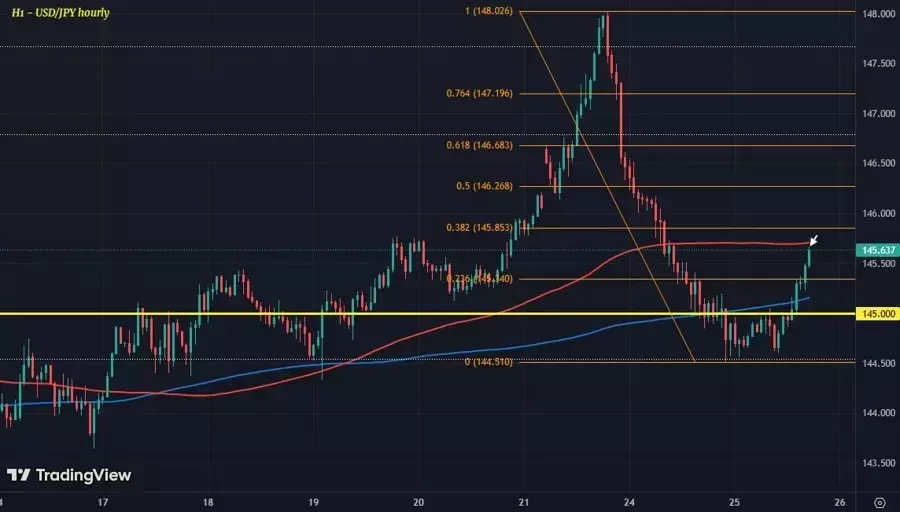
On a serene Wednesday, the 25th of June, 2025, during the tranquil European morning trading session, the USD/JPY currency pair registered a subtle uptick, reaching levels around 145.60. This marginal ascent follows a pronounced depreciation earlier in the week, specifically an impactful plunge from the 148.00 mark, culminating in an overnight low near 144.50. This preceding decline was primarily influenced by two significant global developments: the peaceful de-escalation of tensions between Iran and Israel, which reduced safe-haven demand for the US dollar, and recent dovish comments from Federal Reserve Governor Bowman, suggesting a potential shift in monetary policy.
A critical technical indicator for the pair's current trajectory is its ability to climb above the 145.00 psychological threshold, and more importantly, surpass its 200-hour moving average, positioned at 145.15. This particular movement has provided an opportunity for bullish traders to navigate the pair towards its 100-hour moving average, currently resting at 145.70. Should the currency pair maintain its position below this latter moving average, the immediate market sentiment is likely to hover around a neutral bias. However, a decisive breach above the 145.70 level could signal a renewed bullish momentum for the pair.
Despite these technical signals hinting at potential upside, the presence of strong resistance levels, including the 38.2% Fibonacci retracement level at 145.85 and additional sell orders clustered near the 146.00 handle, may serve to cap any substantial gains for the USD/JPY in the near term. Market participants are not anticipating any novel policy indications from Federal Reserve Chairman Powell's second day of congressional testimony. Consequently, the attention of traders will largely pivot towards forthcoming economic indicators from the United States, particularly as month-end portfolio rebalancing considerations begin to emerge.
Across the wider foreign exchange landscape, other currency pairs such as EUR/USD are largely static, holding around 1.1598, reflecting a broad lack of significant directional impetus for the dollar. Similarly, the yields on 10-year Treasury bonds remain unchanged at 4.295%, and S&P 500 futures show no discernible movement, all of which underscore the current calm pervading the financial markets. This collective stability suggests that the minor appreciation in USD/JPY is best interpreted as a technical recoil from recent lows, rather than an indication of a fundamental shift in broader market dynamics.
From a journalist's perspective, this subtle upward movement in the USD/JPY pair, amidst an otherwise tranquil market, underscores the nuanced interplay of geopolitical events, central bank pronouncements, and technical analysis in the intricate world of currency trading. The immediate implications of events like the de-escalation of the Iran-Israel conflict, coupled with central bank rhetoric, can swiftly impact currency valuations, as seen in the dollar's recent weakening. However, the subsequent technical retracement in USD/JPY highlights that market movements are often complex, comprising both fundamental drivers and technical corrections. This situation serves as a valuable reminder for both seasoned traders and new observers of the forex market: while major news events provide initial impetus, the subsequent price action often involves a measured rebalancing and assessment of technical levels, making a comprehensive analytical approach essential for informed decision-making.