Australia's Central Bank: Rate Cut Expected, Yet Inflationary Pressures Persist
Australia's central bank is at a pivotal juncture, with financial markets largely anticipating a reduction in its benchmark interest rate. However, a closer examination of economic indicators reveals a more complex landscape, suggesting the central bank may opt for a more cautious approach, defying widespread expectations. The interplay of inflation metrics, labor market dynamics, and productivity trends presents a compelling argument for maintaining the current monetary policy stance, at least for the immediate future. This nuanced scenario highlights the delicate balance central banks must strike between supporting economic growth and managing inflationary pressures, especially in an environment characterized by persistent cost pressures.
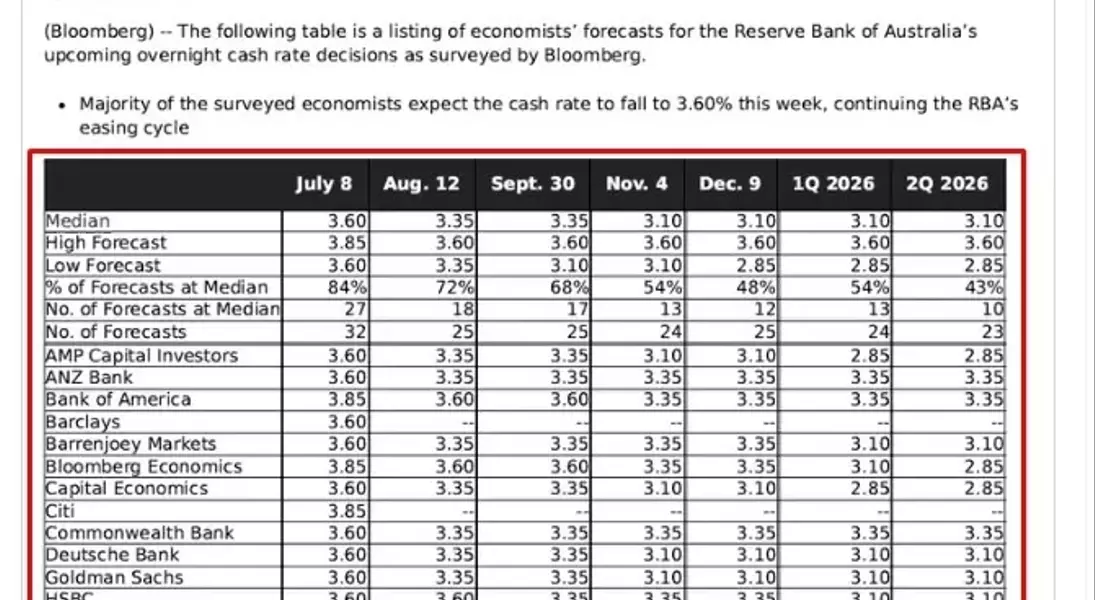
The forthcoming announcement from the Reserve Bank of Australia is scheduled for July 8, a date eagerly awaited by market participants and economists alike. While a consensus among analysts leans towards a rate reduction, there's a significant divergence of opinion, underscoring the uncertainty surrounding the RBA's next move. The decision will hinge on the central bank's interpretation of recent economic data, particularly concerning price stability and employment conditions. The outcome will not only impact Australia's domestic economic trajectory but also resonate across global financial markets, given the country's prominent role in the commodity and financial sectors.
Anticipated Rate Reduction vs. Inflationary Headwinds
Financial markets and a majority of economic forecasters are widely expecting the Reserve Bank of Australia to implement a cash rate cut on Tuesday, July 8. This anticipation is largely driven by a general outlook that might prioritize stimulating economic activity amidst perceived slowing growth. A poll conducted by Reuters, involving numerous economists, revealed that a substantial majority—31 out of 37—forecast a 25 basis point reduction in the RBA's cash rate. This broad expectation suggests a prevailing sentiment that a looser monetary policy is warranted to support the Australian economy.
Despite the prevalent anticipation of a rate cut, a dissenting perspective, notably articulated by Bank of America analysts, contends that the RBA could choose to hold its current policy. This argument is anchored in several key economic concerns. The core issue revolves around underlying inflation, which, despite some easing in headline figures, remains stubbornly high. Specifically, the trimmed mean inflation gauge, a crucial metric for the RBA, is projected to surpass the central bank's 2.5% midpoint target in the upcoming quarterly data release at the end of July. Furthermore, the Australian labor market continues to show tightness, with the unemployment rate anticipated to stay below the RBA's estimated full employment level of 4.2%. Adding to these concerns are elevated unit labor costs, exacerbated by persistently weak productivity growth, which pose significant upside risks to future inflation. These factors combined paint a picture where cutting rates prematurely could reignite inflationary pressures, compelling the RBA to exercise caution and potentially delay any easing measures.
Economic Indicators Driving RBA's Deliberation
The Reserve Bank of Australia's upcoming monetary policy decision is clouded by a complex set of economic signals, prompting debate among experts. While many anticipate a rate cut, Bank of America offers a counter-narrative, emphasizing persistent inflationary pressures. Their analysis highlights that key inflation metrics, particularly the trimmed mean, are likely to exceed the RBA's target. Concurrently, the labor market remains robust, with the unemployment rate staying below the central bank's desired level. This tightness in the labor market, combined with elevated unit labor costs stemming from sluggish productivity, presents a formidable challenge to the RBA's inflation control mandate. Such a backdrop suggests that easing policy could be counterproductive, potentially fueling further price increases rather than fostering sustainable growth.
The current economic environment in Australia is characterized by a delicate balance between the desire for economic stimulus and the imperative of price stability. The widespread expectation for a rate cut stems from a general assessment of economic conditions that might lean towards supporting demand. However, the opposing view, which advocates for a hold on rates, is firmly rooted in the risks posed by entrenched inflation. If the trimmed mean inflation gauge indeed surpasses the 2.5% midpoint target, and the unemployment rate continues to defy expectations by remaining below 4.2%, the RBA would face a difficult choice. Lowering rates under these circumstances could undermine efforts to bring inflation back within the desired range, potentially necessitating more aggressive tightening later. The persistence of high unit labor costs, a direct consequence of subdued productivity, further complicates the picture, as it indicates a structural component to inflation that may not respond effectively to a simple rate adjustment. Therefore, the RBA's decision on July 8 will be a critical reflection of its assessment of these interwoven economic forces and its commitment to long-term price stability.