Canadian Job Market Surges in May, Unemployment Rate Declines
Canada's labor market demonstrated remarkable strength in May, with job creation far surpassing economists' predictions and the unemployment rate experiencing an unexpected decline. This robust performance signals a potentially more resilient economic landscape, offering new insights into the nation's financial health and the potential trajectory of its monetary policy. The data reveals significant shifts in both full-time and part-time employment, along with sectoral and demographic contributions to this positive outcome, challenging previous assumptions about the Canadian economy's state.

The latest Statistics Canada report for May revealed a substantial increase of 83,100 jobs, a figure that dramatically exceeded the consensus expectation of no change. This strong showing follows a more modest increase of 8,800 jobs in the preceding month. Concurrently, the national unemployment rate experienced a surprising dip to 6.9%, contrary to analysts' forecasts that anticipated an increase to 7.1%. This reduction is particularly noteworthy given that the unemployment rate had been on a steady upward trend since July 2022, reaching 4.8% at that time, and had previously touched highs not seen since 2016, excluding the pandemic period.
A deeper dive into the employment data highlights key components of this growth. Full-time employment saw an increase of 13,500 positions, though this was a deceleration compared to the previous month's addition of 57,700 full-time roles. Conversely, part-time employment witnessed a significant surge, adding 69,500 jobs, a stark reversal from the prior month's decline of 48,800 part-time positions. The labor force participation rate also edged up to 65.4% from 65.3%, indicating more individuals entering or actively seeking employment. Average hourly wages, a crucial measure of inflationary pressure and consumer purchasing power, increased by 3.2%, a slight moderation from the 3.5% growth observed previously.
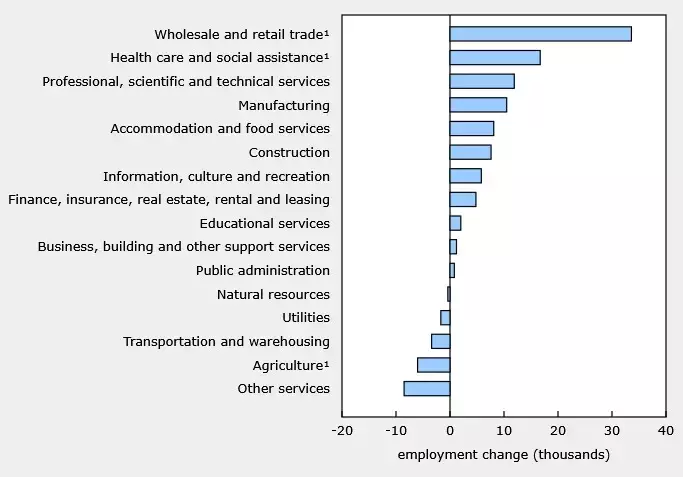
From a sectoral perspective, the job gains were broad-based across various regions. Notably, the wholesale and retail trade sectors were significant contributors, accounting for approximately 34,000 new jobs. The healthcare sector also showed strong growth, adding around 17,000 positions. Demographically, men in their core working age (25-54 years) were a primary driver of the increase, with about 62,000 individuals from this group securing employment. While Canadian job data is known for its volatility, making definitive conclusions challenging, the widespread nature of these gains suggests a genuine improvement in labor market conditions. The positive employment figures have had an immediate impact on currency markets, with the USD/CAD pair reacting by declining from 1.3689 to 1.3652, essentially erasing any prior movements linked to external economic uncertainties. This labor market strength is likely to influence the Bank of Canada's stance on monetary policy, potentially moving them further towards a cautious position. Current market pricing suggests a limited expectation of further interest rate reductions this year, with only about 23 basis points of easing anticipated.
The latest employment statistics for May indicate a strong rebound in the Canadian job market, characterized by significant job creation and an unexpected drop in the unemployment rate. This positive shift is largely attributable to broad-based gains across various sectors and a notable increase in labor force participation. The implications of these figures extend to the nation's central bank, which may now adopt a more reserved approach to monetary policy adjustments, as the economy shows clearer signs of revitalization.