Eurozone Money Supply Growth in June: A Closer Look
Recent economic figures from the Eurozone indicate a measured increase in the M3 money supply during June, alongside steady growth in lending to both consumers and businesses. This trend aligns with expectations following the European Central Bank's recent policy actions, underscoring a stable, albeit not rapidly expanding, financial environment. The subdued growth in overall money supply, when viewed against the backdrop of proactive monetary easing by the central bank, suggests a period of gradual adjustment rather than significant market shifts.
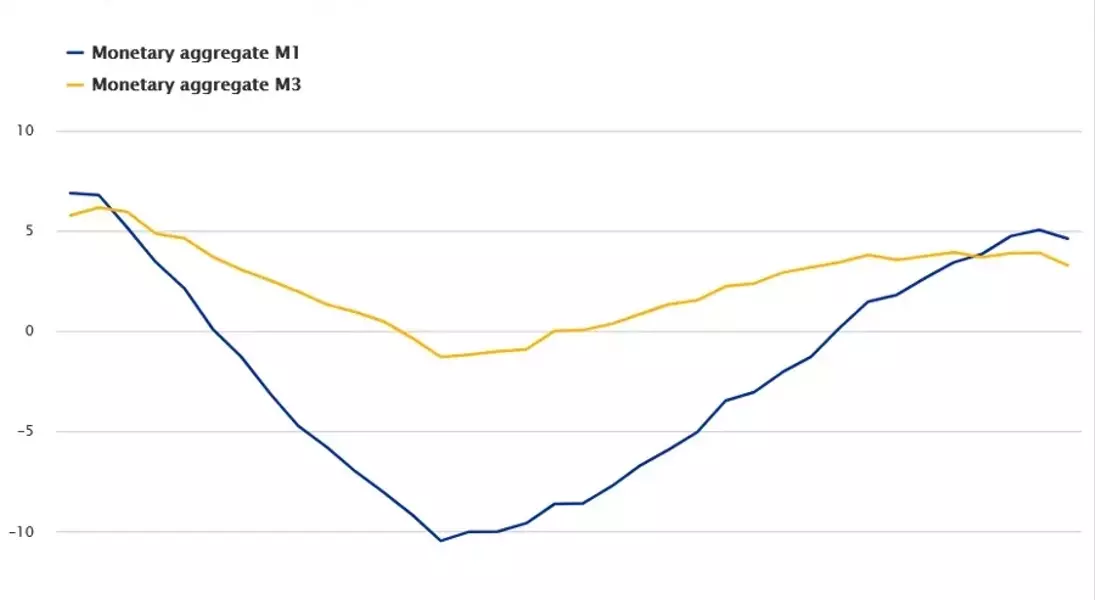
Eurozone Financial Landscape: June's Key Data Unveiled
On a significant day for financial markets, July 25, 2025, the European Central Bank (ECB) disseminated its latest monetary statistics for the Eurozone, shedding light on the region's financial pulse. The comprehensive report highlighted that the M3 money supply, a broad measure of liquidity within the economy, experienced a year-on-year expansion of 3.3% in June. This figure, while reflecting continued growth, was slightly below the 3.7% increase that market analysts had largely predicted.
Digging deeper into the components of this monetary aggregate, the data revealed a consistent uplift in credit activity. Loans extended to households saw a modest rise of 2.2% year-on-year, a slight improvement over the previous period's 2.0%. Similarly, corporate lending recorded a 2.7% year-on-year increase, surpassing the prior month's 2.5% growth. These granular insights into household and corporate borrowing patterns offer a clearer picture of economic activity across the Eurozone.
Analysts widely observed that these developments were largely in line with the current trajectory of the European Central Bank's accommodative monetary policy. The measured growth rates, particularly for the M3 money supply, were not deemed significant enough to trigger substantial shifts in market sentiment or immediate policy adjustments. Instead, they appear to confirm the ongoing, anticipated effects of the ECB's strategies aimed at fostering economic stability and growth within the European Union's currency bloc.
From a journalist's perspective, these figures, while not groundbreaking, offer crucial insights into the effectiveness of central bank policies. The fact that the money supply growth was within the realm of expectation, even if slightly lower than forecasts, suggests a predictable response to the ECB's easing measures. It reinforces the idea that in today's interconnected global economy, central banks face the delicate task of calibration. Their actions are not always about immediate, dramatic impacts, but often about steering the economy through subtle, consistent nudges. This report emphasizes the ongoing need for vigilant observation of monetary indicators, as they serve as vital barometers for economic health and the efficacy of financial governance.