EURUSD in Crucial Battle Between Key Support and Moving Average Resistance
EURUSD: A Pivotal Stand-Off Between Bearish Pressure and Bullish Resilience
Defending the Long-Term Floor: The Crucial Support Zone for EURUSD
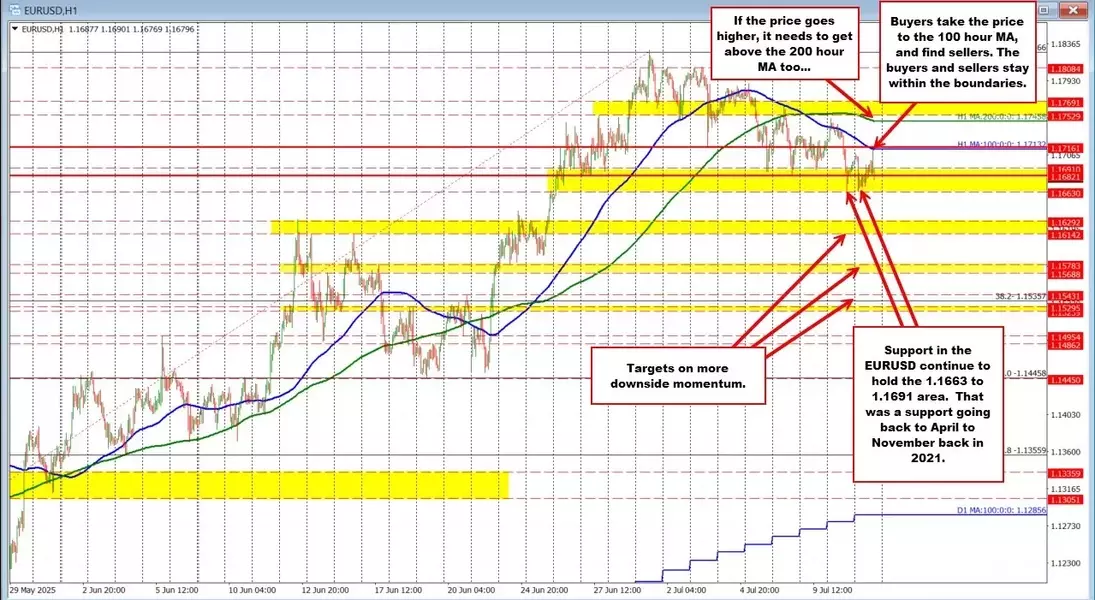
The EURUSD pair consistently finds robust buying interest within the 1.1663 to 1.1691 region. This particular price corridor has proven to be a formidable technical anchor, extending its influence as far back as the period between April and November 2021. Throughout the current trading week, every attempt to push the currency lower into this zone has been met with determined buyers, underscoring the zone's profound significance. A decisive breach below this well-tested support would be a strong indicator of a shift in the immediate market sentiment towards a bearish outlook.
The Uphill Battle: Encountering Moving Average Resistance
Conversely, the upward momentum of the EURUSD has been consistently impeded by key moving averages. The 100-hour moving average, presently situated around 1.1713, has acted as a significant ceiling, with selling pressure intensifying at this level. Further above, the 200-hour moving average, near 1.1745, provides an additional layer of overhead resistance. For the time being, the currency pair remains confined within these clear boundaries—strong support below and persistent resistance above, creating a period of consolidation.
Potential Downside Targets: What Happens if Support Fails?
Should the EURUSD falter and break below its established support area, several lower price targets come into play. The path downwards could lead to the 1.1614–1.1629 swing area. Beyond that, the 1.1568–1.1578 zone presents another potential stopping point. A more significant retreat could see the pair test the 38.2% Fibonacci retracement level of its May-to-July ascent, positioned at approximately 1.15357.
Path to Upside Momentum: Overcoming Key Averages
Conversely, if bullish sentiment prevails and buyers manage to propel the price above both the 100-hour and 200-hour moving averages, it would signal a notable shift in market dynamics. Such a move would likely empower buyers, setting the stage for an assault on the annual highs, with the most recent peak noted around 1.1827.
Navigating the Current Range: A Call for Patience
Until a definitive breakout occurs—either above the prevailing resistance levels or below the critical support zone—market participants should anticipate continued sideways trading within the clearly defined technical boundaries. The current environment necessitates a patient approach, as a clear directional signal has yet to emerge.