Intel's Q2 2025 Performance: Revenue Surpasses Expectations Amidst Significant Losses
Intel's recent financial disclosure for the second quarter of 2025 presents a complex picture of its operational health. While the technology giant successfully surpassed revenue projections, it simultaneously reported considerable losses, largely attributed to extensive restructuring activities and various one-time costs. This performance has left market observers with a cautious outlook, as the company navigates a fiercely competitive landscape, particularly within the client computing and data center sectors. Analysts note that while there are promising areas, such as the potential impact of new chip technologies, Intel's journey toward sustained profitability and market leadership is fraught with significant hurdles.
During the second quarter of 2025, Intel achieved a revenue of $12.9 billion, a figure consistent with the previous year's performance and exceeding the consensus estimate of $12 billion. However, this positive revenue trend was overshadowed by a reported adjusted loss of $0.10 per share, which fell short of analysts' expectations for a $0.01 gain. A major contributing factor to this deficit was a massive $1.9 billion in restructuring charges, resulting from an approximately 15% reduction in its workforce. Although these charges were excluded from the adjusted earnings per share (EPS), other significant financial impacts, including $800 million in impairment charges and $200 million in additional one-time expenses, collectively reduced adjusted EPS by 20 cents. Consequently, the company recorded a GAAP net loss of $2.9 billion.
Delving into the performance of specific business divisions, Intel's client computing group generated $7.9 billion in revenue, surpassing the anticipated $7.4 billion. Similarly, the data center and artificial intelligence (AI) segment delivered $3.9 billion, exceeding its $3.6 billion target. Looking ahead to the third quarter, Intel's guidance projects revenue between $12.6 billion and $13.6 billion, with the midpoint comfortably above the $12.7 billion consensus. However, the forecast for adjusted EPS remains at break-even, trailing the expected 4 cents.
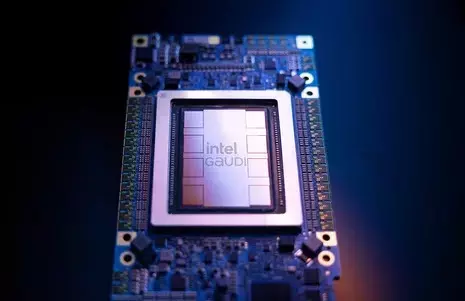
Industry analysts have offered varied perspectives on Intel's results. Bernstein highlighted that the company's long-term strategy holds more weight than its immediate financial outcomes, pointing out persistent structural challenges. While the personal computer (PC) business might see some short-term benefits from trade tariffs, it is not perceived as a sustainable growth engine. Conversely, Bank of America suggested that Intel's new 18A chip manufacturing process and an impending enterprise refresh cycle could provide upward momentum. Nevertheless, the intense rivalry from competitors like AMD and Nvidia, coupled with Intel's acknowledged deficiency in advanced AI accelerators, continues to pose significant competitive pressures.
Intel's recent earnings report underscores the intricate balance between achieving revenue targets and managing substantial financial outflows, primarily due to ambitious strategic overhauls. The company's performance reflects its ongoing efforts to adapt within a rapidly evolving technological landscape, where innovation and market positioning are critical. Despite some positive indicators in key market segments, the path to sustained financial health and competitive parity will require continued strategic execution and careful navigation of both internal transformation and external market dynamics.