Leading AI Chipmakers: Nvidia vs. Broadcom
Unveiling the AI Chip Titans: A Comparative Analysis
The Ascendancy of Specialized Chipmakers in AI
In the dynamic landscape of artificial intelligence, two prominent chip manufacturers, Nvidia and Broadcom, have carved out significant niches. Each company commands its respective segment within the AI semiconductor market, exhibiting remarkable expansion. Their recent financial disclosures underscore their substantial lead over competitors such as Advanced Micro Devices and Intel in the AI chip arena. This begs the question for investors looking to capitalize on the burgeoning AI chip market: which of these industry giants presents a more compelling investment opportunity?

Nvidia's Unrivaled Dominance in AI Graphics Processing
Nvidia holds a commanding position in the market for AI graphics processing units (GPUs), which are crucial components for handling complex AI workloads in data centers. These powerful processing units are instrumental in training large language models and are increasingly being adopted for AI inference tasks. Industry reports indicate Nvidia's near-monopoly in the global GPU market, a testament to its technological superiority and strategic manufacturing partnerships. From the groundbreaking A100 GPUs used to train ChatGPT to the latest Blackwell processors, Nvidia consistently pushes the boundaries of performance. Its robust relationship with TSMC, ensuring a significant allocation of advanced chipmaking capacity, further solidifies its market stronghold. This strategic advantage positions Nvidia to capture a substantial share of the projected multi-trillion-dollar AI chip market, driving impressive revenue growth and maintaining its status as a premier AI investment.
Broadcom's Prowess in Custom AI Processors
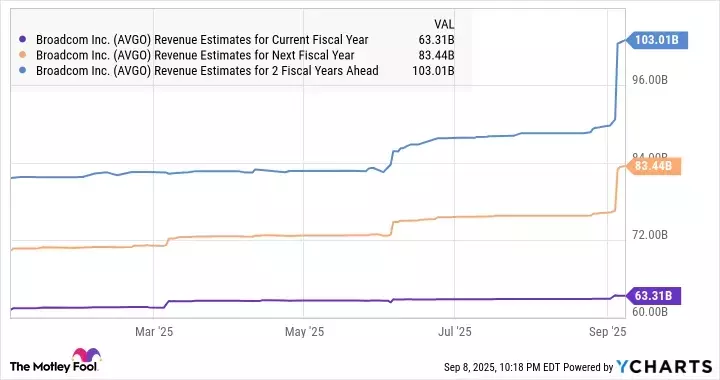
Beyond general-purpose GPUs, application-specific integrated circuits (ASICs) are gaining traction in AI data centers due to their tailored efficiency for specific tasks. Broadcom has emerged as the leader in this domain, reportedly controlling a significant portion of the ASIC market. Major cloud computing and AI firms are increasingly relying on Broadcom to design custom AI processors that help optimize their operational expenses. The company's AI revenue has surged, with projections indicating a substantial increase in the coming fiscal year, partly fueled by a significant order from OpenAI. Broadcom's strategic engagements with multiple cloud hyperscale customers for AI ASIC development suggest a vast addressable market and considerable potential for sustained AI revenue growth. This strong pipeline of custom AI projects underscores Broadcom's critical role in the evolving AI hardware ecosystem.
Investment Outlook: Valuation and Growth Potential
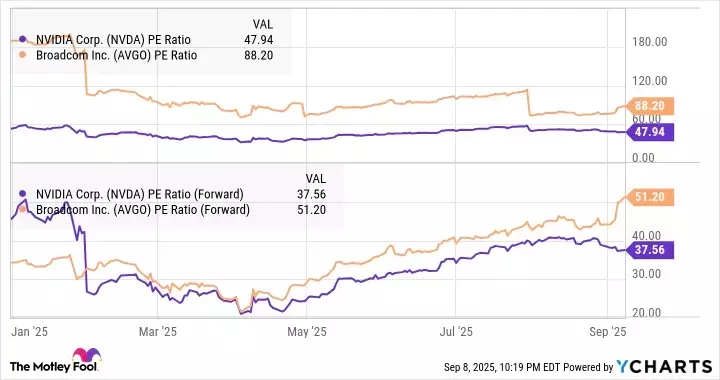
While both Broadcom and Nvidia exhibit robust growth trajectories and maintain strong market positions in their respective AI chip segments, a closer examination of their valuations reveals differing investment profiles. Nvidia's earnings multiples appear more favorable compared to Broadcom's, especially considering Nvidia's faster bottom-line growth. For investors prioritizing a blend of value and growth, Nvidia may present a more attractive proposition. However, Broadcom's promising AI revenue pipeline and its strategic importance in custom ASIC development suggest that its current premium valuation could be justified. Therefore, investors with a higher tolerance for risk might find Broadcom to be a valuable addition to their growth-oriented portfolios, anticipating its continued expansion within the high-growth AI sector.