OPEC Revises Down Global Oil Demand Projections for Upcoming Years
The Organization of the Petroleum Exporting Countries (OPEC) has recently issued updated projections for worldwide oil consumption in the coming years. Their latest report indicates a downward adjustment in demand figures for the period spanning from 2026 to 2029. Despite these revisions, the consortium steadfastly asserts that global oil demand has yet to reach its zenith, maintaining a robust long-term growth outlook that distinctly contrasts with analyses from other major industry participants.
Detailed Insights into OPEC's Revised Oil Demand Outlook
In a significant update released on Thursday, July 10, 2025, OPEC unveiled its revised forecasts for global oil demand. According to the organization's current assessment, the average daily world oil demand for the year 2026 is now anticipated to be 106.3 million barrels per day (bpd), a notable decrease from the previous year's estimate of 108 million bpd. Furthermore, the forecast for 2029 has been recalibrated to 111.6 million bpd, representing a reduction of 700,000 bpd compared to last year's figures. Interestingly, while these near-to-medium term projections have been lowered, OPEC has opted to retain its 2030 forecast at an average of 113.3 million bpd, mirroring its prior estimation.
This revised outlook from the influential oil-producing bloc presents a striking divergence when compared to the projections made by other prominent energy institutions. For instance, the International Energy Agency (IEA) envisions global demand reaching its peak at 105.6 million bpd by 2029, followed by a subsequent decline from 2030 onwards. This stark contrast highlights OPEC's more optimistic stance, a characteristic that has frequently been observed in its historical forecasts, often necessitating subsequent downward adjustments.
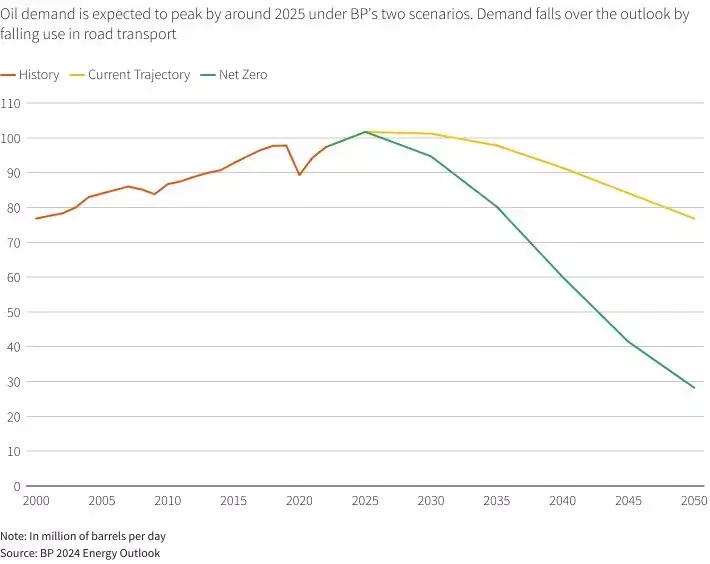
Addressing the rationale behind these more modest short-term projections, OPEC acknowledges a deceleration in demand expansion within the vibrant Chinese economy. However, the organization firmly reiterates its conviction that there is "no peak oil demand on the horizon." Taking a particularly bold stance, OPEC projects that global oil demand will continue its upward trajectory for decades to come, ultimately reaching an astounding 122.9 million bpd by the year 2050. This long-range forecast stands in considerable opposition to the expectations of other industry titans, such as BP, which typically present a more conservative outlook on future oil consumption trends.
Reflections on the Future of Global Energy Consumption
The latest pronouncements from OPEC regarding global oil demand invite critical reflection on the multifaceted dynamics shaping the future of energy. As a market observer, one cannot help but notice the persistent divergence in forecasts between OPEC and other reputable entities like the IEA or BP. This ongoing disparity underscores not only the inherent complexities of predicting future energy landscapes but also highlights the differing strategic perspectives among key players. While OPEC's unwavering optimism regarding sustained oil demand growth signals a belief in the enduring relevance of hydrocarbons, it simultaneously brings into focus the imperative for all stakeholders to carefully assess the underlying assumptions and potential disruptors. The acknowledgment of slowing demand in China, despite the broader bullish stance, serves as a crucial reminder that shifting economic gears and evolving environmental policies, particularly in major consuming nations, will inevitably influence energy pathways. Ultimately, navigating this evolving terrain demands a nuanced understanding that balances economic realities with the accelerating drive towards sustainable energy solutions.