Unlocking Financial Growth: Passive vs. Residual Income Explained
Master Your Money: Differentiating Passive and Residual Income for Smart Financial Decisions
Decoding Passive Income: Earning with Minimal Ongoing Effort
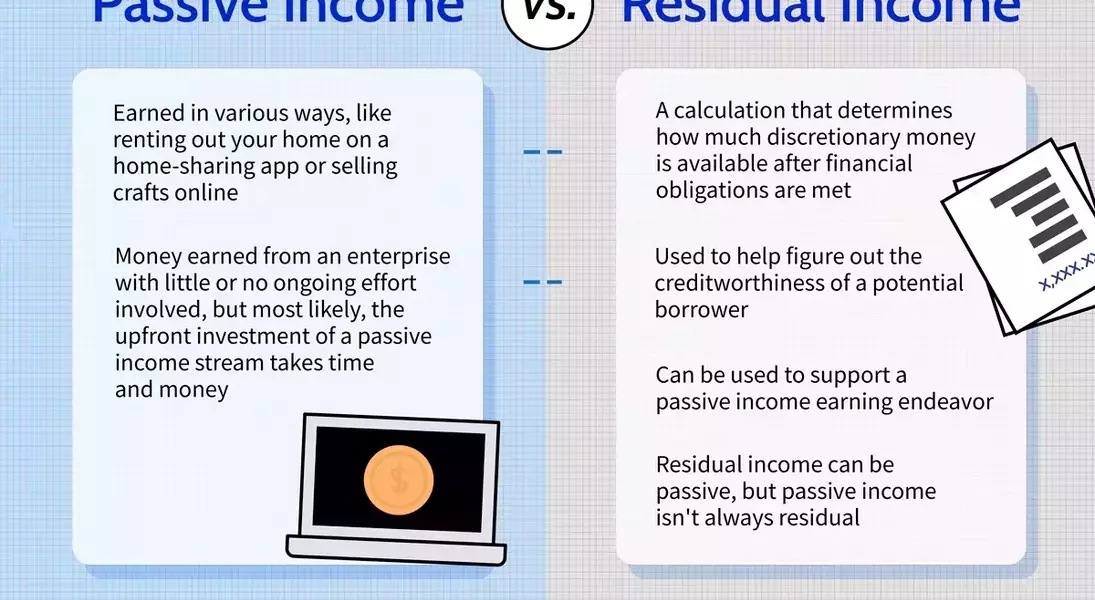
Passive income refers to financial gains that necessitate little to no continuous work. Once established, these income streams can regularly generate revenue, similar to returns from investments or peer-to-peer lending. The Internal Revenue Service (IRS) categorizes it separately from earned income, as it's typically derived from assets or ventures where direct, active involvement is minimal. Achieving substantial passive income can liberate individuals from traditional employment, offering more freedom and time for other pursuits. While the initial setup might involve some risk, a well-structured passive income strategy can significantly bolster financial security over the long term.
The Essence of Residual Income: Beyond Expenses and Debts
Residual income is a financial metric that varies in meaning depending on its context within personal finance, corporate finance, or equity valuation. Fundamentally, it represents the leftover funds after all financial obligations have been met. Unlike passive income, which focuses on the source of earnings, residual income highlights the amount of disposable funds available after accounting for expenditures.
Residual Income in Your Personal Finances: Assessing Borrowing Capacity
In personal finance, residual income signifies the capital an individual retains after settling all personal debts and expenses. This figure is critical for evaluating a potential borrower's creditworthiness. For instance, lending institutions use residual income to gauge an applicant's capacity to manage a mortgage. They calculate it by deducting mortgage payments, property insurance, taxes, and other monthly obligations (such as credit card payments or student loans) from the applicant's total monthly income. The remaining balance, which excludes essential living costs like food and utilities, is considered the individual's residual income.
Residual Income in Corporate Contexts: Measuring Profitability and Performance
Within the realm of corporate finance, residual income is synonymous with a company's net operating income that surpasses its required rate of return. It represents any profit left after a company has covered all its capital costs. This metric is frequently employed to assess the effectiveness of capital investments or the overall performance of specific business units.
Residual Income in Equity Valuation: Estimating Stock Value
In the domain of equity valuation, residual income functions as an economic earnings stream and a valuation tool for estimating a stock's worth. The residual income valuation model assesses a company's value by summing its book value and the present value of its anticipated future residual income. This amount is derived by subtracting the net cost of capital from the net income. For investment valuation, residual income denotes the net income generated beyond the minimum acceptable rate of return.
Distinguishing Key Concepts: Passive vs. Residual Income
While often used interchangeably, passive income and residual income are distinct concepts. Passive income refers to earnings generated with minimal direct effort, such as dividends, royalties, or rental income. Residual income, conversely, represents the funds remaining after all expenses and financial obligations are paid, applicable to both individuals and businesses. The specific definitions of these terms are contingent on the particular circumstances of the individual or entity. Understanding these differences is essential for accurate financial planning and strategy development.
Cultivating Passive Income: Strategic Approaches
There are various accessible avenues to generate passive income. These can include renting out a spare room or an entire property on weekends, transforming hobbies into revenue streams by selling photographs or crafts online, or delving into investments like stocks and peer-to-peer (P2P) lending. Each method offers a unique path to building consistent earnings with reduced active participation.
Active Income: The Foundation of Traditional Earnings
Active income is earned through direct engagement in employment, typically in the form of salaries, hourly wages, tips, or commissions. This type of income requires a direct exchange of time and effort for compensation. In contrast, passive income allows for earnings with considerably less time commitment, providing financial flexibility and diversification.
Taxation of Passive and Residual Income: Key Considerations
Passive income is subject to taxation, though often at different rates compared to active income. The amount of tax owed depends on various factors, including the source of income (e.g., financial investments versus real estate). In a personal finance context, residual income is the surplus from active income after expenses, and therefore, it is not taxed as a separate income stream.