US Jobless Claims Decline, Indicating Labor Market Resilience
Resilience in the Workforce: Unpacking the Latest US Job Data
A Closer Look at Initial Unemployment Filings: Steadfastness Amidst Predictions
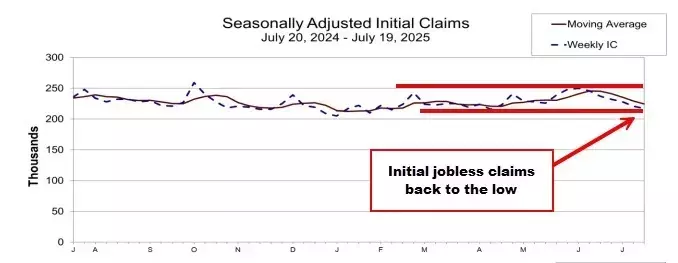
The latest figures from the United States reveal that initial jobless claims have settled at 217,000, undershooting the forecasted 226,000. This is a noticeable reduction from the previous week's adjusted total of 221,000, signaling a potential robustness in the job market. This metric, which serves as an early indicator of layoff trends, suggests that fewer individuals are experiencing new unemployment spells than anticipated by market analysts.
The Trajectory of Continued Claims: A Glimpse into Sustained Employment
Beyond the initial shock of job loss, the number of individuals receiving ongoing unemployment benefits, known as continuing claims, also showed a positive trend. The most recent count stood at 1.955 million, slightly below the estimated 1.960 million. Although marginally higher than the prior week's revised figure of 1.951 million, the overall stability in this area indicates that a significant portion of those who lose jobs are quickly finding new opportunities or that the duration of unemployment is not extending dramatically.
Insights from the Four-Week Averages: Unwavering Strength
To smooth out weekly volatility and provide a clearer picture of underlying trends, analysts often look at the four-week moving averages. The four-week moving average for initial claims decreased to 224,500 from the previous 229,500. Similarly, the four-week moving average for continuing claims edged down to 1.954 million from 1.95625 million. These averages consistently point towards a resilient labor market, challenging any notions of widespread employment weakness. The consistent decline in the initial claims' four-week average is particularly noteworthy, suggesting that the recent single-week dip is part of a broader pattern rather than an isolated incident.
Broader Implications: A Stable Employment Horizon
The collective data, encompassing both initial and continuing jobless claims and their respective four-week averages, strongly indicates that the United States labor market is not currently exhibiting signs of significant fragility. These statistics imply a healthy employment environment, where job losses are not escalating and the number of individuals seeking sustained unemployment assistance remains well-managed. This robust performance in employment indicators typically translates to positive sentiment regarding consumer spending and overall economic stability, providing a reassuring signal for the nation's economic outlook.