US Wholesale Inventories and Sales Report for May 2025
The United States' wholesale sector experienced a notable contraction in May 2025, with both inventories and sales registering a 0.3% decline. This data, released by the Census Department, provides a snapshot of the current economic landscape, highlighting shifts in business stock levels and distribution activity. The consistent reduction across both metrics signals a delicate balance in the supply chain and consumer demand, prompting closer examination of underlying market dynamics.
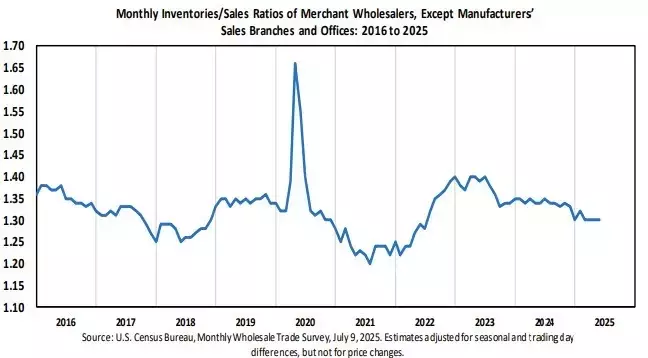
While the monthly figures reflect a slight downturn, a broader perspective reveals a more nuanced picture. Wholesale sales, despite their sequential dip, demonstrated a resilient annual growth, indicating a foundational strength in the sector over the longer term. The inventory-to-sales ratio, a key indicator of market efficiency, held steady, suggesting that businesses are maintaining cautious inventory levels in response to prevailing economic conditions. This equilibrium is crucial for mitigating potential risks and optimizing operational flows within the wholesale trade.
May 2025 Wholesale Activity Overview
The latest statistical release for May 2025 highlights a concurrent 0.3% decrease in both US wholesale inventories and sales. This outcome aligns precisely with the initial preliminary projections for inventories, underscoring a consistent trend in the wholesale sector's performance. The previous month's inventory data was also revised, showing a negligible change, reinforcing the stability of the observed trends.
For May 2025, wholesale sales reached a total of $697.2 billion, representing a 0.3% drop from the figures recorded in April 2025. Conversely, when compared to the same period in the prior year, sales demonstrated a robust growth of 4.8% from May 2024. The April sales data underwent a minor adjustment, shifting from a slight increase to effectively no change when measured against March's performance. Concurrently, wholesale inventories for May 2025 stood at $905.5 billion, reflecting a 0.3% reduction from the previous month. However, annual comparisons indicate a 1.4% increase in inventories since May 2024. The reported month-over-month decline of 0.3% in inventories was consistent with the advance estimate and remained unrevised, affirming the accuracy of initial assessments. The inventory-to-sales ratio for May 2025 held firm at 1.30, mirroring the previous month's ratio. This metric is at its lowest point since 2022, suggesting a potentially leaner inventory management strategy or a quicker movement of goods through the supply chain. In contrast, the ratio for May 2024 was marginally higher at 1.34.
Inventory and Sales Ratio Insights
The inventory-to-sales ratio provides a critical insight into the efficiency of the wholesale supply chain and the alignment between stock levels and demand. In May 2025, this ratio remained stable at 1.30, indicating that for every dollar of sales, businesses held $1.30 in inventory. This steady figure, unchanged from April, points to a disciplined approach to inventory management or perhaps a sustained level of demand that is effectively clearing existing stock.
A comparison with the May 2024 ratio of 1.34 reveals a slight tightening of the ratio over the year, suggesting that inventories are being managed more efficiently relative to sales, or that sales growth is outpacing inventory accumulation. The fact that this ratio is at its lowest point since 2022 is particularly noteworthy. A lower inventory-to-sales ratio can imply several things: a stronger demand that is quickly depleting stock, businesses being more cautious with ordering new stock due to economic uncertainties, or simply an optimized supply chain that reduces the need for large inventories. This trend, if sustained, could suggest increased operational efficiency within the wholesale sector and a quicker turnover of goods, which is generally a positive sign for economic fluidity.