Asian Economic Outlook: Focus on China's June Trade Data and US Relations
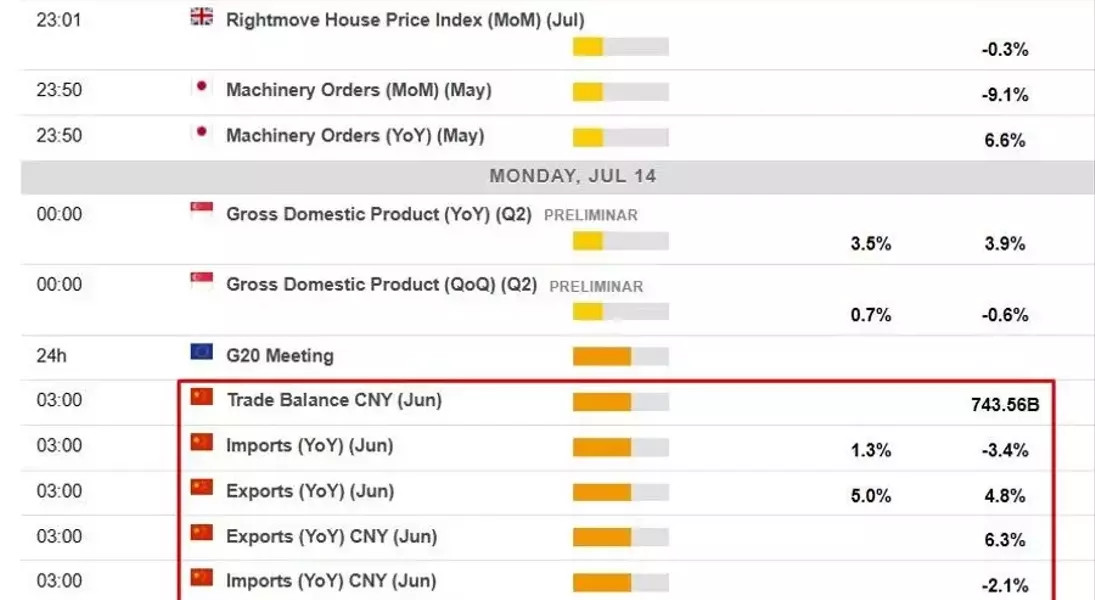
The upcoming Asian economic calendar on July 14, 2025, places significant emphasis on China's trade performance for June. This release is particularly relevant given the recent, albeit limited, advancements in trade relations between China and the United States. Observers anticipate a slight uptick in Chinese export figures, alongside a notable rebound in import volumes. These projections align with the ongoing efforts by both nations to stabilize their economic ties, following a period of heightened tensions. The interplay of these factors will provide crucial insights into the region's economic trajectory.
A critical element influencing the market's perspective is the recent confirmation of a trade agreement between Chinese and US officials. This deal, an affirmation of understandings reached in Geneva, includes China's commitment to increase its provision of rare earth elements to the US. In return, the US has agreed to scale back some of its retaliatory measures. While this signifies a move towards reconciliation, the restricted nature of these agreements suggests that a complete resolution of trade disputes is still a distant prospect. Investors and analysts will closely scrutinize the June trade data to gauge the tangible impact of these diplomatic breakthroughs on China's economic health and its broader implications for global trade flows.
China's Trade Performance in Focus
The spotlight for the Asian economic calendar on July 14, 2025, is firmly on China's trade statistics for June. Analysts are projecting a marginal increase in China's export figures, signaling continued resilience in its outbound shipments. More significantly, there's a consensus expectation for a notable recovery in China's import volumes. These anticipated movements are closely watched indicators of domestic demand and the health of China's manufacturing sector. The data will offer crucial insights into the momentum of the Chinese economy and its contribution to regional and global trade dynamics.
The June trade data will serve as a key barometer for assessing the effectiveness of recent policy adjustments and the overall economic sentiment within China. Export growth, even if modest, would suggest sustained international demand for Chinese goods, while a robust rebound in imports would underscore strengthening internal consumption and industrial activity. These figures are not just isolated statistics; they represent critical components of China's economic narrative, influencing investor confidence, currency valuations, and commodity markets. Market participants will be dissecting every detail to understand the nuanced shifts in China's trade landscape and extrapolate their broader economic ramifications across Asia and beyond.
Navigating US-China Trade Relations
Recent developments in the trade relationship between China and the United States have added another layer of complexity to the upcoming economic announcements. Officials from both countries recently affirmed a partial trade agreement, stemming from earlier discussions in Geneva. This accord involves China boosting its supply of rare earth materials to the US, a strategic concession designed to alleviate critical supply chain concerns for American industries. In exchange, the US has agreed to a reciprocal de-escalation of certain trade countermeasures, reflecting a concerted effort to foster a more constructive dialogue.
However, it is imperative to acknowledge that the scope of these recent agreements is distinctly limited, addressing specific pain points rather than broad systemic issues. This cautious approach indicates that while a complete normalization of trade relations remains aspirational, both sides are seeking pragmatic solutions to immediate challenges. The impact of these narrowly defined agreements on the June trade data will be keenly observed, as any positive ripple effects could signal a gradual thawing of tensions. Conversely, a lack of significant improvement in trade figures despite these diplomatic gestures might suggest that deeper structural issues persist, requiring more comprehensive strategies for long-term stability and growth in US-China economic interactions.