CoreWeave: A Promising Alternative in the AI Cloud Infrastructure Market
The artificial intelligence cloud infrastructure sector is witnessing robust growth, with major cloud computing providers heavily investing in data center capacity. While Nebius Holdings recently experienced a significant stock surge due to a substantial contract with Microsoft, CoreWeave emerges as a strong contender. This company is demonstrating impressive financial performance and holds a considerable market advantage in terms of capacity and valuation, positioning it as an attractive investment in this burgeoning market.

CoreWeave: A Deep Dive into its AI Cloud Infrastructure Prowess
On September 9, 2025, Nebius Holdings experienced a dramatic stock increase, soaring by nearly 50% following the announcement of a monumental $19.4 billion contract with Microsoft. This agreement, set to span until 2031, grants Microsoft access to Nebius's specialized AI data center in New Jersey, powered by graphics processing units (GPUs) to handle extensive AI workloads. This development underscores the escalating demand for dedicated AI infrastructure.
Amidst this market excitement, CoreWeave, a prominent player in the same domain, also saw its stock climb over 7%. Similar to Nebius, CoreWeave specializes in providing GPU-accelerated data centers for AI and machine learning tasks. The company emphasizes that its infrastructure is meticulously designed for AI applications, enabling customers to achieve quicker market entry and enhance operational efficiency.
CoreWeave's financial performance highlights its strong position. In the second quarter of 2025, the company's revenue surged by 207% to an impressive $1.2 billion. Even more compelling is its revenue backlog, which reached $30.1 billion, an increase of nearly $14 billion from the previous year. This backlog reflects substantial contracts secured from industry giants like OpenAI and Google Cloud, with OpenAI alone awarding CoreWeave contracts totaling $15.9 billion this year.
The growing contractual obligations of major cloud computing providers, such as Microsoft's 35% year-over-year increase in remaining performance obligations to $368 billion, explain the increasing reliance on specialized AI infrastructure providers like CoreWeave and Nebius. Microsoft's decision to partner with Nebius to meet its surging AI computing demands further illustrates this trend. Notably, Microsoft is CoreWeave's largest customer, contributing 62% to its top line in 2024. Other significant clients include Meta Platforms and IBM.
CoreWeave's commitment to expanding its capacity is evident in its operations. By the end of the last quarter, it managed 33 AI data centers across North America and Europe, boasting an active power capacity of 470 megawatts (MW). The company aims to nearly double this to 900 MW by year-end and holds a contracted data center capacity of 2.2 gigawatts (GW). This capacity significantly surpasses Nebius's active capacity of 220 MW and its projected 1 GW contracted capacity by the end of next year.
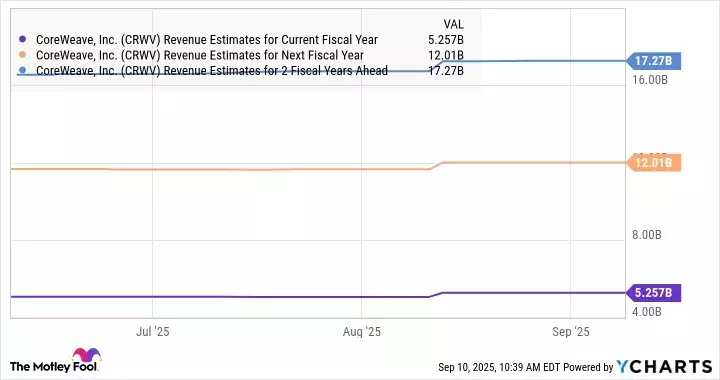
With a projected addressable market reaching $400 billion by 2028, CoreWeave is well-positioned for sustained growth. Furthermore, its current valuation, trading at less than 14 times sales, stands in stark contrast to Nebius's price-to-sales ratio of 91, making CoreWeave a more attractively priced investment. Industry analysts forecast a more than threefold increase in CoreWeave's revenue within two years. Should CoreWeave achieve $17 billion in revenue and trade at just 5 times sales—a multiple comparable to the Nasdaq Composite Index—its market capitalization could reach $85 billion, representing a 73% increase from current levels, with potential for even greater gains.
The rapid expansion of the AI sector presents unprecedented opportunities for specialized infrastructure providers. CoreWeave's strategic investments in capacity, strong client relationships, and favorable valuation suggest a promising future. For investors seeking exposure to the AI boom, CoreWeave offers a compelling combination of growth potential and financial prudence.