Japan's Leading Economic Indicators Show Upward Revision in May
Recent statistics from Japan's Cabinet Office reveal an upward adjustment in the nation's economic outlook for May, with the leading indicator index demonstrating a notable rise. This revision offers a glimpse into the future trajectory of the Japanese economy, suggesting a potential for improved conditions ahead. Concurrently, the coincident index, which reflects present economic activity, maintained its position, indicating a period of stability after previous downturns. These figures provide critical insights for analysts and policymakers alike, painting a nuanced picture of Japan's economic resilience and its path forward.
On July 25, 2025, the Japan Cabinet Office disseminated updated economic statistics for the month of May. The leading indicator index, a crucial barometer for foreseeing future economic trends, recorded an ascent to 104.8. This marks an improvement from the earlier reported figure of 104.2, signaling a more optimistic short-term economic outlook than previously estimated. This revision could be attributed to various factors, including evolving global trade dynamics, shifts in consumer confidence, or specific domestic policy impacts that were not fully captured in the initial assessment.
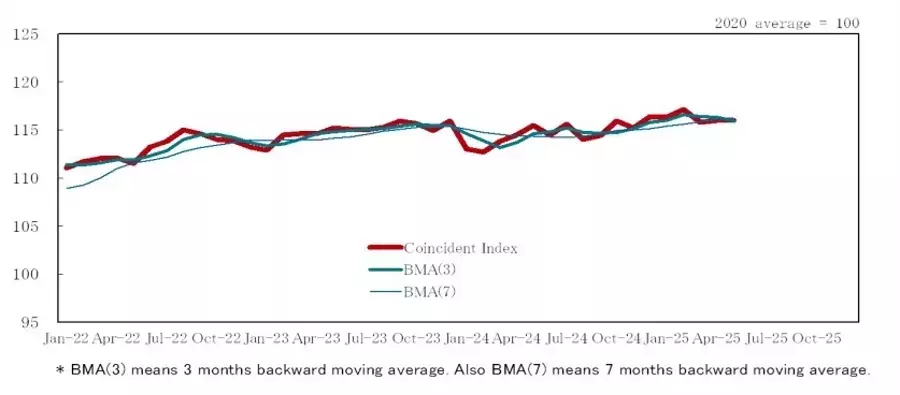
In parallel, the coincident indicator index, which offers a real-time snapshot of current economic conditions, held steady at 116.0. This value is consistent with the figures observed in April, implying a period of sustained current economic activity. The official evaluation of this index remains unaltered, characterized by a phrase indicating that its descent has ceased. This particular assessment, "halting to fall," is noteworthy as it suggests that the period of contraction or slowdown in economic activity might be concluding, paving the way for potential stabilization or recovery in the near future. The consistency of this index points to an economy that, for the moment, is neither expanding nor contracting significantly but rather finding a temporary equilibrium.
Examining the trajectory of the coincident index over recent years provides a broader context for these latest figures. A detailed analysis of its historical performance reveals patterns of cyclical fluctuations, demonstrating how various internal and external shocks have impacted Japan's economic vitality. Understanding these historical trends is essential for forecasting future movements and for appreciating the significance of the current stability. While the leading index hints at potential growth, the stable coincident index suggests that immediate improvements in daily economic life may take time to materialize fully. This balance of forward-looking optimism and current steadiness shapes the ongoing discourse among economic observers regarding Japan's enduring economic health.
The updated economic indices from Japan offer a mixed but generally encouraging perspective on the nation's financial landscape. While the leading indicator's upward revision suggests brighter prospects on the horizon, the coincident index's consistent performance underscores a current state of economic equilibrium. This dual insight emphasizes the importance of closely monitoring future developments to ascertain the full impact of these trends on Japan's economic trajectory.