Market Tensions Easing, But FOMC Remains a Key Concern
Navigating August's Economic Currents: From Trade Relief to Fed Vigilance
Trade Agreements Reshape August's Economic Outlook
The global economic calendar initially marked August 1st as a date fraught with significant financial uncertainty. Previously, expert analysis, including insights from institutions like Deutsche Bank, had pointed to a trio of major flashpoints that could trigger market turbulence. However, the dynamic of global trade relations has seen a notable positive shift, with recent developments actively working to alleviate these concerns. Breakthrough trade agreements forged between key economic blocs, such as the comprehensive deals struck by Japan and the European Union, have played a pivotal role in this de-escalation, transforming the initial ominous forecast into a considerably less volatile scenario.
U.S.-China Trade Truce: A Delicate Dance Towards Extension
Adding to the amelioration of global trade tensions are ongoing discussions aimed at extending the current trade ceasefire between the United States and China. These crucial negotiations, which commenced earlier this week in Sweden, are anticipated to continue as both nations seek to prolong the existing truce, set to expire on August 12th. While the general sentiment leans towards a probable extension, or even potentially more favorable terms, it remains imperative for market participants to acknowledge the inherent, albeit minor, risks associated with such high-stakes deliberations. The outcome of these talks carries significant implications for international trade stability.
The Federal Reserve's Looming Influence: A Hawkish Undercurrent
Despite the positive trajectory in international trade relations, a notable degree of apprehension persists regarding the upcoming meeting of the Federal Open Market Committee (FOMC). While the consensus among financial observers is that a rate cut is unlikely at this juncture, there appears to be a pervasive sense of complacency in the market concerning the potential for a more assertive stance from the central bank. Critical economic indicators, such as a robust U.S. labor market that continues to show minimal signs of weakening, and inflation metrics that suggest persistent underlying price pressures, lend credence to the possibility of the FOMC issuing a more hawkish statement or Jerome Powell adopting a firmer tone in his post-meeting press conference. This potential hawkish pivot could introduce unexpected volatility into an otherwise calming market environment.
Market Resilience Amidst Uncertainty: The S&P 500's Current Stance
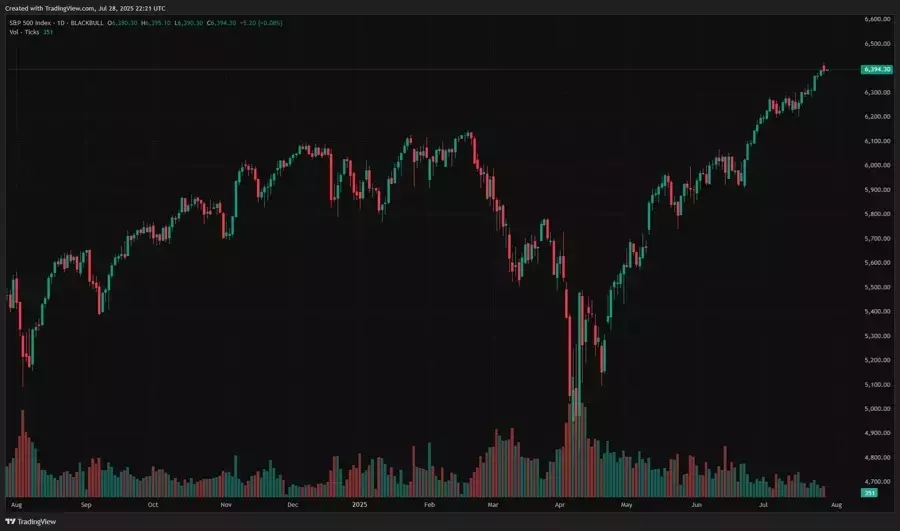
The resilience of the S&P 500 index (SPX) in the face of these economic crosscurrents presents a compelling paradox. The index has maintained its upward momentum, reflecting either a genuine strength in underlying fundamentals or a potentially unwarranted market complacency. The daily charting of the SPX invites investors and analysts alike to critically assess whether the current robust performance is indicative of a healthy economic backdrop or merely a reflection of an overconfident market that may be overlooking lingering risks, particularly those emanating from central bank policy. The market's interpretation of these signals will be crucial in determining its near-term trajectory.