Navigating the S&P 500: A Strategic Approach to Current Market Dynamics
Smart Investing: Balancing Growth and Risk in the Current S&P 500 Climate
Understanding the S&P 500's Central Role in the Investment World
The S&P 500 index stands as a fundamental measure for the broader stock market, comprising approximately 500 prominent U.S. corporations with large market capitalizations. Its widespread adoption by investors underscores its significance as a market indicator. For many decades, individual investment strategies have often struggled to consistently outperform this comprehensive market benchmark.

The Trajectory Leading to Today's Market Conditions
The S&P 500 has consistently achieved new peak values over recent years. This upward trend is significantly fueled by a concentrated group of major technology companies heavily involved in artificial intelligence. These firms, frequently referred to as the 'Magnificent Seven,' generate substantial revenues and are perceived as primary beneficiaries of the burgeoning AI sector. Consequently, they are allocating hundreds of billions towards AI-related capital investments. Many of these companies now boast market valuations exceeding $1 trillion, with a leading AI chip manufacturer surpassing $4 trillion.
The Impact of Market Concentration and Investor Concerns
Owing to their substantial scale, these seven companies collectively account for over 30% of the S&P 500. While this concentration has fueled the S&P 500's exceptional performance, it also sparks apprehension among investors due to the high valuations of these tech giants. There's concern about the potential repercussions for the broader market if the AI revolution encounters obstacles, affecting these dominant stocks. Even the overall S&P 500 currently trades at a forward price-to-earnings (P/E) ratio of 23, which is above its historical average. Although the enthusiasm for AI is understandable, drawing parallels to the internet boom and the subsequent dot-com bubble suggests a need for caution, despite their inherent differences.
Optimizing Your Investment in the S&P 500
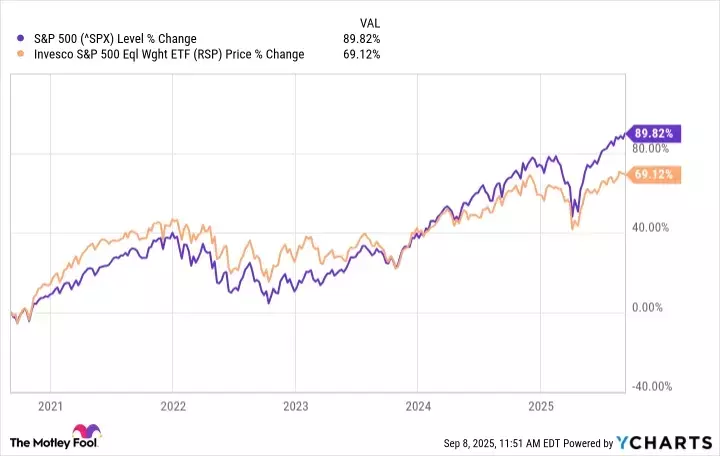
Given the aforementioned market dynamics, the most judicious approach to investing in the broader benchmark this month, in my assessment, involves acquiring shares in the Invesco S&P 500 Equal Weight ETF. This particular index fund deviates from the traditional market-cap weighting of the S&P 500 by providing uniform exposure to all its constituent companies. This strategy effectively mitigates the concentration risk associated with the dominant 'Magnificent Seven' firms.
Weighing Equal-Weight vs. Traditional S&P 500 Investments
Historically, over the last half-decade, the conventional S&P 500 has outpaced its equal-weighted counterpart, primarily driven by the stellar performance of technology and AI sectors. While the Invesco ETF may not surpass the S&P 500's performance in the immediate future, it offers a crucial safeguard against potential downturns in the market. Furthermore, by diversifying beyond the index's largest constituents, an equal-weighted fund could potentially yield superior long-term returns. Notably, the Invesco ETF currently trades at a more attractive forward P/E ratio of approximately 18, making it a more cost-effective option than the standard benchmark.
Strategic Investment Choices Amidst Market Uncertainty
For more aggressive investors with a long-term perspective, direct investment in the S&P 500 remains a viable option, provided they are prepared for increased market volatility. Historically, the market has consistently recovered from crashes and recessions to achieve new highs, delivering substantial returns. Employing dollar-cost averaging when investing in S&P 500 tracking ETFs can help smooth out the cost basis over time. However, for those prioritizing the optimal way to invest in the S&P 500 currently, the Invesco S&P 500 Equal Weight ETF stands out, especially considering present valuations and the prevailing economic and monetary policy uncertainties