Significant Surge in US Mortgage Applications as Rates Decline
The latest data from the Mortgage Bankers Association (MBA) reveals a substantial increase in mortgage application activity across the United States. This upturn, observed in the week concluding on July 4, indicates a dynamic shift in the housing finance landscape, driven by evolving interest rates. The surge in both purchase and refinance indices suggests a heightened level of consumer engagement in the real estate sector, reflecting a responsiveness to current market conditions.
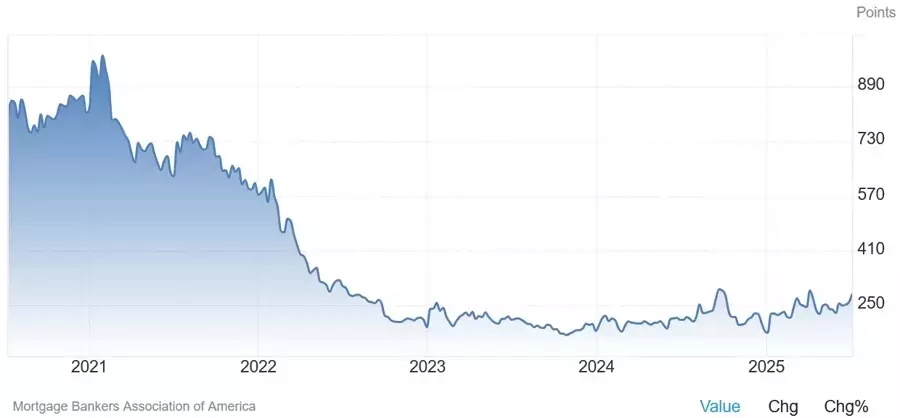
This renewed interest in mortgage applications, particularly for refinancing, highlights the sensitivity of borrower behavior to even marginal fluctuations in lending rates. While these weekly figures are not typically seen as major market movers, they provide valuable insights into the underlying health and trajectory of the housing market. The intertwining relationship between mortgage rates and application volumes continues to be a crucial indicator for analysts and policymakers alike, painting a picture of consumer confidence and financial accessibility in the property sector.
Mortgage Application Growth and Market Dynamics
In the week ending July 4, 2025, mortgage applications in the US surged by an impressive 9.4%, marking a significant acceleration from the previous week's 2.7% increase. This notable jump reflects a growing appetite among consumers for both new home loans and refinancing existing ones. The underlying factor contributing to this upswing appears to be a modest, yet impactful, reduction in the 30-year fixed mortgage rate, which edged down to 6.77% from 6.79%. This slight decrease in borrowing costs seems to have been sufficient to stimulate demand, indicating that potential homeowners and those looking to refinance are highly sensitive to interest rate movements.
Drilling down into the specifics, the Market Index advanced to 281.6 from 257.5, demonstrating an overall increase in market activity. The Purchase Index, a key measure of demand for loans to buy homes, saw a rise to 180.9 from 165.3. This suggests that despite the prevailing high interest rate environment, more individuals are proceeding with property acquisitions. Concurrently, the Refinance Index experienced a robust increase, climbing to 829.3 from 759.7. This substantial growth in refinancing activity underscores how a slight dip in mortgage rates can prompt existing homeowners to seize opportunities to adjust their loan terms, potentially lowering their monthly payments. The inverse correlation between mortgage applications and interest rates remains a consistent pattern, with even minor rate reductions triggering noticeable spikes in application volumes.
The Impact of Interest Rates on Housing Finance
The recent uptick in mortgage applications directly illustrates the profound influence of interest rates on the housing finance sector. Historically, a consistent inverse relationship has been observed: as mortgage rates decrease, the volume of loan applications tends to increase, and vice versa. This trend holds true for both new home purchases and the refinancing of existing mortgages. The slight moderation in the 30-year fixed mortgage rate, dropping from 6.79% to 6.77%, served as a catalyst for the latest surge in applications, highlighting the acute sensitivity of borrower decisions to even minimal shifts in lending costs.
For prospective homebuyers, a reduction in mortgage rates translates into more affordable monthly payments, thereby enhancing purchasing power and making homeownership more accessible. Similarly, for current homeowners, lower rates present an opportune moment to refinance, potentially reducing their interest burden over the life of the loan or freeing up capital for other financial endeavors. While the weekly report from the Mortgage Bankers Association is not typically considered a primary driver of broader market movements, it serves as a critical barometer for consumer confidence and the immediate responsiveness of the housing market to monetary policy and economic conditions. This interconnectedness underscores the delicate balance within the financial ecosystem, where small changes in one area can ripple across various segments, influencing investment and consumer behavior significantly.