US Import Prices Show Modest Gain in June, Export Prices Rebound
Newly released economic data for June reveals a nuanced landscape for U.S. international trade, with import prices recording a more subdued increase than anticipated, while export prices staged a notable recovery. This divergence in price movements provides key insights into inflationary pressures and global demand for American goods.
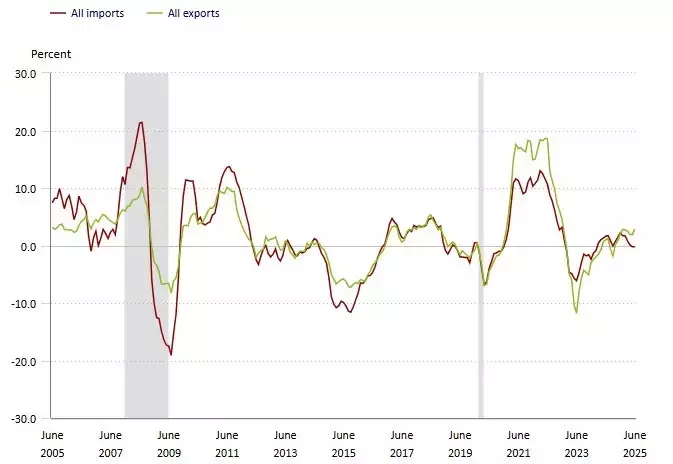
The latest figures from the Bureau of Labor Statistics underscore a complex interplay of factors influencing trade costs. Although monthly import price gains were modest, a significant rebound in export prices signals resilience in external demand. Understanding these shifts is crucial for assessing broader economic trends and their potential impact on policy decisions.
Understanding the Import Price Dynamics
In June, U.S. import prices advanced by a marginal 0.1% month-over-month, falling short of the anticipated 0.3% increase. This modest rise is particularly noteworthy given a downward revision to May's figures, which now stand at -0.4% instead of the previously reported 0.0%. Despite this monthly uptick, import prices remain 0.2% lower compared to the same period last year, mirroring the annual decline observed in the preceding month. This persistent year-over-year decrease suggests a continued moderation in the cost of goods entering the country, potentially easing some inflationary pressures. A deeper dive into the components reveals varying trends: prices for imported foods, feeds, and beverages declined by 0.8%, while capital goods imports remained stable. In contrast, import prices for consumer goods showed a significant 0.4% increase, representing the largest monthly rise since February 2024, indicating specific sectors are experiencing greater price adjustments.
The nuanced performance of import prices in June presents a detailed view of current trade cost dynamics. The monthly increment, while positive, was less robust than forecasted, even after accounting for a negative adjustment to the previous month's data. This implies that the overall inflationary impact from incoming goods might be less severe than initially projected. From an annual perspective, the consistency in the 0.2% decline for import prices, year-on-year, suggests a stable disinflationary trend. This broader stability contrasts with the month-to-month fluctuations seen in specific categories. For instance, the reduction in prices for agricultural imports, alongside unchanged capital goods prices, paints a picture of controlled costs in critical economic segments. However, the notable increase in consumer goods import prices, the highest in several months, points to potential upward pressure on everyday household expenses, signaling that consumers might start to feel the pinch from rising costs in certain product lines.
Export Price Recovery and Market Implications
Conversely, U.S. export prices demonstrated a strong resurgence in June, increasing by 0.5% month-over-month. This rebound follows a decline in May, with the previous month's figure revised to -0.6% from -0.9%. On a year-over-year basis, export prices have climbed 2.8%, marking their highest level since January. This robust performance suggests a healthy global demand for American products. Breaking down the export figures, non-agricultural export prices saw a 0.5% rise, while agricultural export prices increased by an even stronger 0.8%. The latter was primarily driven by higher prices for meat and soybeans, which more than compensated for a decrease in fruit prices. This agricultural boost represents the highest monthly increase for the sector since October 2024, highlighting strong demand in key commodity markets.
The significant recovery in U.S. export prices during June signals positive developments for the nation's trade balance and overall economic outlook. The 0.5% monthly gain indicates that demand for American goods is strengthening internationally, allowing exporters to command higher prices. This trend is further reinforced by the 2.8% year-on-year increase, which is the most substantial annual growth witnessed since the beginning of the year. The resilience in export pricing suggests that, despite global economic uncertainties, American goods remain competitive and in demand. Particularly notable is the agricultural sector's strong performance, with a substantial 0.8% rise in prices, primarily driven by robust demand for staple products like meat and soybeans. This indicates strong global food commodity markets and provides a positive outlook for U.S. agricultural producers, while the broad-based increase across non-agricultural exports further solidifies the positive momentum in America's trade landscape.