USD/JPY: Navigating Market Dynamics Ahead of Japanese Election
The USD/JPY currency pair finds itself at a pivotal juncture, exhibiting consolidation near a crucial resistance threshold as attention turns to the impending Japanese upper house election this weekend. The global currency landscape has seen the U.S. dollar display a mixed performance, particularly in the aftermath of recent inflation figures that showed both Core CPI and Core PPI falling short of predictions. While the greenback has shown strength against commodity-linked currencies, its gains have been less pronounced when compared to the Euro or British Pound. This observed sideways movement post-CPI release might be attributed to existing market positions, as a significant number of traders have recently favored shorting the U.S. dollar, making it a crowded trade susceptible to sharp reversals. Simultaneously, the Japanese Yen's near-term outlook is intricately tied to the outcome of U.S.-Japan trade negotiations and the Bank of Japan's potential policy adjustments.
From a fundamental standpoint, the U.S. dollar's recent movements reflect a market that has largely recalibrated its expectations for Federal Reserve policy, returning to pre-week pricing levels despite the latest data. On the Japanese side, the focus remains squarely on the developments in U.S.-Japan trade relations, which the Bank of Japan views as a primary determinant for future policy decisions. A favorable resolution in these trade talks is widely expected to bolster the JPY, potentially prompting traders to anticipate an earlier interest rate hike by the Bank of Japan. The critical period for these developments is identified between July 20 and August 1, encompassing both the Japanese upper house election and a significant deadline for a trade agreement. The election results, particularly whether the ruling coalition maintains its majority, could significantly influence the yen's immediate appreciation, with current polls suggesting a potential loss of majority that may have contributed to the yen's recent weakness. Should these polls prove inaccurate, and the ruling bloc secure its majority, a robust rally in the yen could ensue, driven by renewed optimism for a U.S.-Japan trade deal and accelerated rate hike expectations.
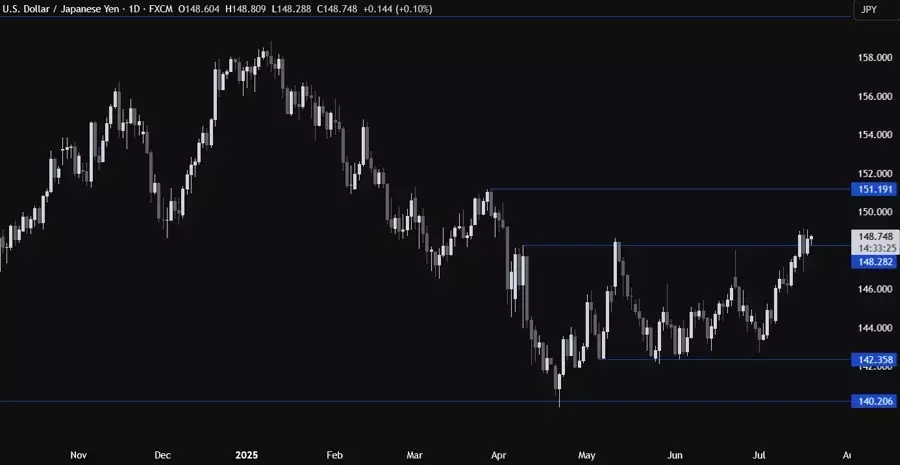
Analyzing the USD/JPY pair from a technical perspective, the daily chart reveals a persistent consolidation pattern around the 148.30 resistance level. Bullish traders are accumulating positions at these levels, targeting a potential ascent towards the 151.20 mark. Conversely, bearish participants are closely watching for a decisive break below the 148.30 support, which would likely intensify selling pressure and open the path towards the 142.35 support level.
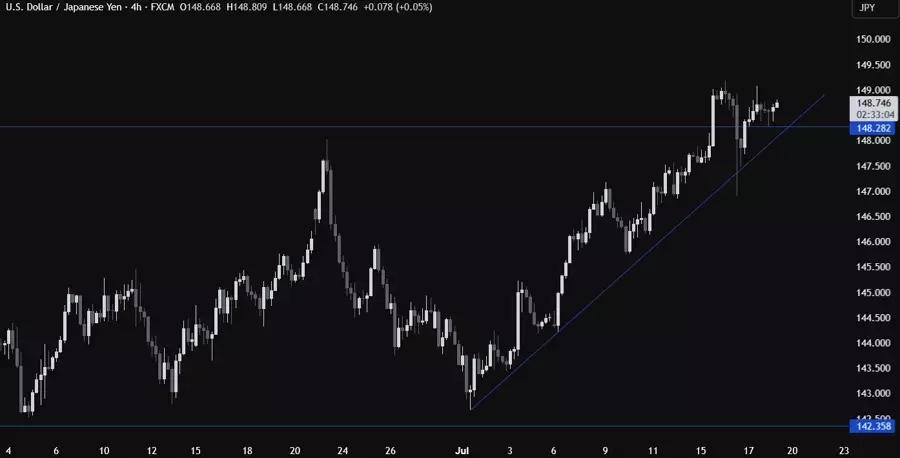
Zooming in on the 4-hour chart, an ascending trendline clearly defines the prevailing bullish momentum. For risk-conscious traders, opportunities to initiate long positions are more favorable around this trendline, aiming for a move to 151.20. Conversely, sellers are poised to increase their bearish bets if the price breaks below this trendline, with a target of 142.35.
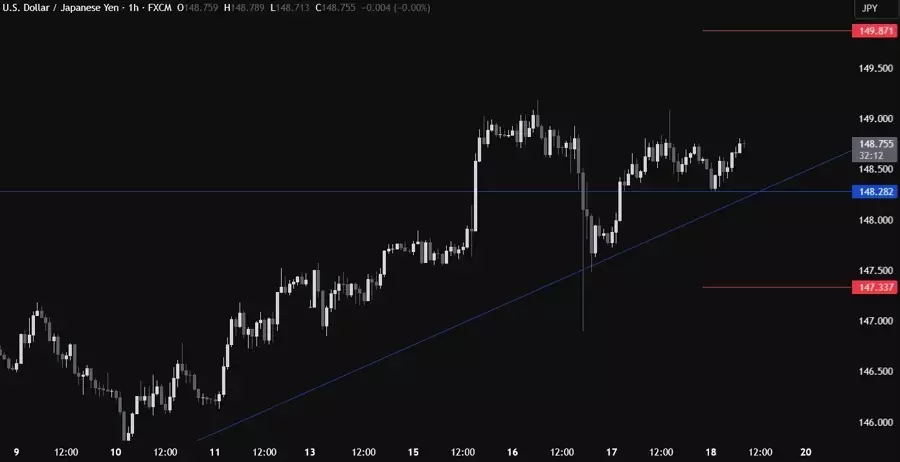
On the 1-hour chart, the established technical patterns persist. Buyers are expected to seek opportunities to enter positions during pullbacks towards the trendline, while sellers will be looking for a downside breakout to initiate fresh declines. The defined red lines on this chart delineate the average daily range for current trading sessions, providing a clear reference for intraday volatility.
Looking ahead, the week concludes with the release of the University of Michigan Consumer Sentiment survey, a key economic indicator that could influence market sentiment. However, the most significant event on the horizon remains the Japanese upper house election over the weekend, whose outcome is set to play a decisive role in the near-term direction of the USD/JPY pair.
The intricate interplay of economic data, political events, and technical thresholds continues to shape the trajectory of the USD/JPY pair. The market remains highly sensitive to shifts in U.S. monetary policy expectations and, critically, the political landscape in Japan and the progression of bilateral trade negotiations. Traders and investors are advised to monitor these developments closely, as they hold the key to the pair's next significant move.