USDCAD Navigates Choppy Waters After Tariff-Induced Volatility
Navigating the Storm: USDCAD's Post-Tariff Consolidation
Initial Market Reaction to Trade Policy Shifts
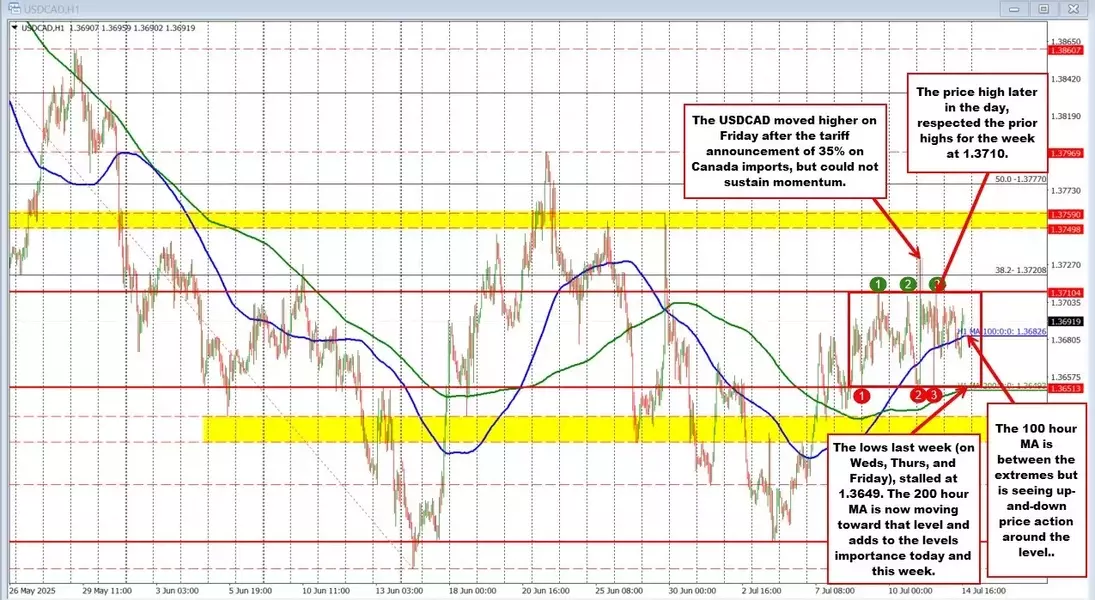
On a recent Friday, the USDCAD pair saw a swift, but ultimately unsustainable, upward movement. This immediate reaction was prompted by the United States President's official communication to Canadian Prime Minister Mark Carney, detailing an impending 35% import tariff on Canadian goods, effective August 1st. The stated justifications for this measure included national security concerns, specifically related to fentanyl trafficking, and a persistent trade imbalance. While the initial announcement created a bullish impetus, the market quickly corrected itself, pulling the currency pair back from its highs.
Failed Breakout Attempts and Established Trading Boundaries
Despite the initial tariff-driven upward pressure, the USDCAD's attempt to breach a significant resistance level at 1.3710, a prior swing high from earlier in the week, was unsuccessful. Furthermore, the pair failed to hold above the 38.2% Fibonacci retracement level of the downward trend from the May peak, situated at 1.37208. This inability to maintain upward momentum indicated that bullish forces were unable to capitalize on the initial surge. Subsequently, after retreating below 1.3710, the pair briefly tested this level again during the North American trading session, buoyed by stronger-than-anticipated job figures. However, it once again encountered strong selling pressure, confirming the 1.3710 area as a formidable resistance point.
Technical Indicators and Key Support Levels Guiding the Pair
As the market digested these developments, the USDCAD began to gravitate back towards its 100-hour moving average, currently positioned around 1.3682. This moving average has served as a crucial pivot point, reflecting the currency pair's tendency for range-bound and volatile trading since the prior Wednesday. Concurrently, the 200-hour moving average is also ascending, converging towards the 1.3649-1.3651 support zone. This particular range has demonstrated robust support for the USDCAD over the past week, acting as a floor for price action on multiple occasions.
Future Outlook: Awaiting Decisive Moves Beyond Current Constraints
The failure of the USDCAD to sustain the momentum generated by the tariff news implies a degree of caution among market participants, possibly influenced by the pre-existing exemptions under the USMCA trade agreement. Until the currency pair can convincingly break above the 1.3710 mark and the 38.2% retracement at 1.37208, or decisively move below the 1.3649 support level, which aligns with last week's short-term lows and the 200-hour moving average, traders should anticipate continued two-way price action. The various moving averages will remain vital technical guides, dictating the pair's trading corridors in the near term.