USDCAD Poised for Upside Momentum as Key Support Levels Hold Firm
In recent trading, the USDCAD currency pair experienced a notable dip during the Asian and early European sessions, only to find significant technical support, successfully halting its downward movement. This pivotal rebound has invigorated buyers, shifting the market's attention towards potential upward targets. The pair's capacity to remain above key technical thresholds is paramount for maintaining this newfound bullish momentum. Traders are now keenly observing whether the pair can overcome established resistance levels to confirm a more decisive bullish bias in the short to medium term. Failure to hold these support levels, however, could reverse the current positive outlook, bringing downside targets back into play.
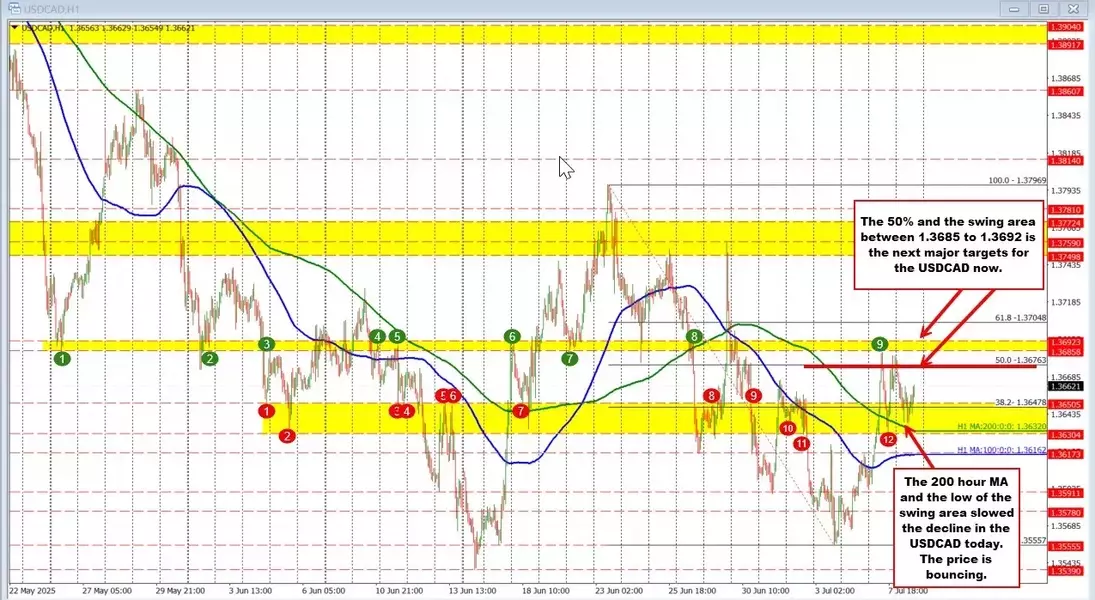
USDCAD Rebounds from Critical Support, Eyes Future Resistance
On Tuesday, July 8, 2025, the USDCAD currency pair demonstrated remarkable resilience. Following a decline during the Asian and initial European trading hours, the pair discovered substantial support around its 200-hour moving average, precisely at 1.3632, and the lower boundary of a key swing area near 1.3630. This strong defensive stand effectively arrested the early selling pressure, paving the way for a significant bounce back. The market's short-term dynamics subsequently shifted, with momentum swinging firmly back in favor of the buyers. Crucially, the USDCAD pair successfully reclaimed territory above the 38.2% Fibonacci retracement level of its descent from the June high, currently positioned at 1.3676.
Looking ahead, the immediate challenge for the reinvigorated buyers lies in breaching the 50% retracement level of the move from the June peak, also residing around 1.3676. Beyond this, a formidable test awaits at the well-defined resistance zone between 1.36858 and 1.3692. This particular range has historically served as a critical pivot point, influencing market direction on numerous occasions in recent weeks. Overcoming this hurdle will be indispensable for buyers to assert more definitive control and pave the way for further gains. Conversely, any slip back below the 38.2% retracement level and the 200-hour moving average would undermine the current recovery narrative, potentially reintroducing downward pressure. In such a scenario, traders would turn their focus to subsequent support levels at 1.3616 (the 100-hour moving average), and further down at 1.3591 and 1.3579, as potential downside objectives.
From a journalist's perspective, the USDCAD's recent price action serves as a vivid illustration of how technical analysis can offer crucial insights into market sentiment and potential future movements. The unwavering support observed at key moving averages and swing lows underscores the importance of these traditional indicators in guiding trading decisions. This episode reminds us that even amidst volatile market conditions, identifiable technical patterns can provide a roadmap for understanding price behavior. For traders, this highlights the necessity of not only identifying robust support and resistance levels but also observing how price interacts with these zones, as such interactions often precede significant shifts in market direction. The current situation in USDCAD offers a compelling case study on the interplay of technical factors and market psychology, where confidence among buyers, bolstered by successful defense of key levels, could propel the pair higher, provided they surmount the next series of resistance challenges. It reinforces the idea that in the fast-paced world of currency trading, vigilance and an astute understanding of technical dynamics are indeed the keys to navigating the complex landscape of forex markets.