USDCHF Faces Critical Juncture Between Key Moving Averages
Navigating the Nexus: USDCHF's Weekend Consolidation
Early Week Dynamics and Initial Resistance Encounters
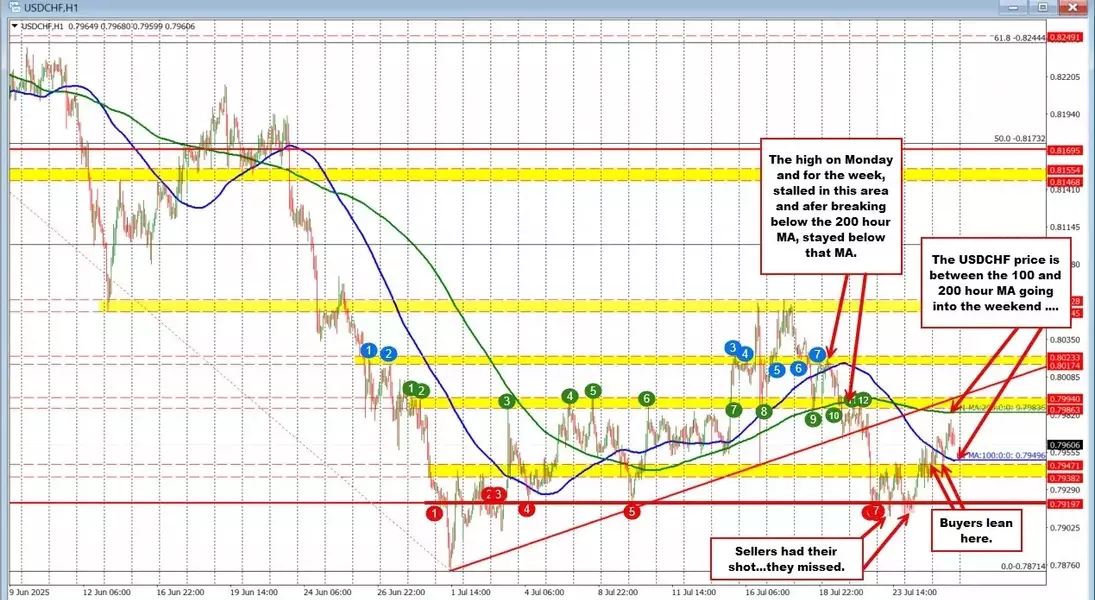
At the beginning of the week, the USDCHF displayed an upward trajectory, with its ascent capped by a significant resistance zone. This pivotal area, situated between 0.8017 and 0.8023, proved to be a formidable barrier for further gains. Following this encounter, the pair experienced a downturn, breaching the 200-hour moving average. This average, currently positioned at 0.79836, subsequently transitioned into a critical resistance level that the pair struggled to overcome throughout the remainder of the week. Sustained movement above this line is essential for a short-term bullish continuation.
Mid-Week Trading: Missed Opportunities for Downward Momentum
By mid-week, bearish sentiment briefly dominated the market, with the USDCHF testing lower support levels. Although the price dipped below the 0.79197 swing area on Wednesday and Thursday, the selling pressure ultimately waned. Bears were unable to capitalize on this momentary weakness, failing to establish a definitive downward trend. Consequently, the currency pair rebounded, though it remained below its 100-hour moving average, indicating persistent underlying resistance.
The Battle for Position: End-of-Week Consolidation
As the week drew to a close, buyers re-emerged, finding solid ground near the 0.79471 support level, which represents the higher boundary of a minor swing area. This renewed buying interest propelled the USDCHF back into the confined space between its 100-hour moving average (at 0.79490) and the 200-hour moving average (at 0.79836). The pair concluded the week in this tightly constrained range, signaling a period of indecision and consolidation.
Anticipating Future Movements: Key Indicators for the New Week
Looking ahead to the next trading week, the 100-hour and 200-hour moving averages are poised to serve as crucial barometers for the USDCHF. A decisive break above the 200-hour moving average would suggest a stronger bullish bias, indicating that buyers are gaining control. Conversely, a sustained drop below the 100-hour moving average would likely empower sellers, pointing towards further downside potential. Traders will closely monitor these levels for clear directional cues.