EURUSD Response to CPI: Technical Resistance at 100-Hour Moving Average
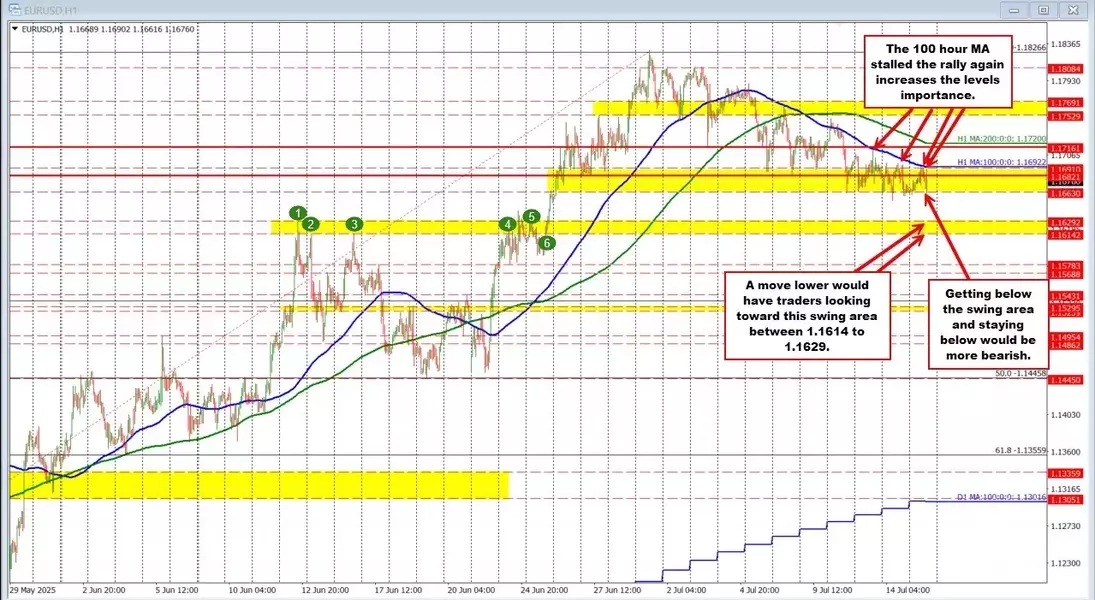
The EURUSD currency pair has recently demonstrated a pattern of constrained upward mobility, particularly in the wake of significant economic data releases. Despite an initial positive reaction to core Consumer Price Index (CPI) data that came in below forecasts, the pair consistently encountered a strong technical resistance point. This pivotal level, identified by the 100-hour moving average, has acted as a consistent ceiling, thwarting several attempts to establish a sustained bullish trend. The repeated rejections at this level underscore its critical importance in shaping the pair's short-term trajectory, indicating that market participants are closely monitoring this technical indicator for cues on future price action.
Moreover, the price action suggests a battle between bullish aspirations and a prevailing bearish undertone, with key support levels also coming into play. The interaction between these established technical boundaries and fresh economic impulses paints a dynamic picture for traders. A decisive breakout above the 100-hour moving average, or a clear breach of identified support zones, would be crucial in signaling a significant shift in market sentiment and opening new trading opportunities.
The Critical 100-Hour Moving Average
The EURUSD pair's reaction to the latest core CPI data, which showed a slightly weaker-than-expected increase, led to an immediate appreciation in its value. However, this bullish momentum was quickly halted as the pair approached the 100-hour moving average. This specific moving average has served as a formidable resistance level on multiple occasions, notably on the day of the CPI release and during the preceding trading session, Friday. Each instance saw buying interest dissipate as the price touched or neared this technical line, preventing any meaningful upward continuation and reinforcing its significance as a ceiling for the currency pair's value.
The consistent rejection of higher prices at the 100-hour moving average at approximately 1.16927 suggests that a strong contingent of sellers is positioned at this level, ready to push the price back down. For the EURUSD to embark on a sustained upward trend, it would necessitate a robust breakthrough of this resistance, accompanied by strong market momentum. Such a move would signal a shift in market control from sellers to buyers, potentially opening the door for further gains. Conversely, the inability to overcome this barrier repeatedly strengthens its technical importance, making it a key indicator for traders assessing the pair's immediate future direction. Its role as a pivotal point cannot be overstated, as future attempts to break higher will be keenly watched by market participants.
Key Support and Resistance Dynamics
Beyond the immediate resistance presented by the 100-hour moving average, the EURUSD also navigates a critical support zone that has historical relevance. The price range between 1.1663 and 1.1691 has functioned as a significant swing area, dating back from April to November 2021. This historical context suggests that these levels have previously marked turning points or consolidation phases for the currency pair. The resilience of this support was tested following the CPI data, with the price dipping marginally below the 1.1663 threshold to 1.16616 before quickly rebounding, reaffirming the area's importance as a floor for price action.
The interplay between this historical support and the current 100-hour moving average resistance defines the immediate trading landscape for the EURUSD. While the moving average acts as a psychological and technical barrier to upside movements, the 1.1663-1.1691 range provides a critical cushion against significant declines. A sustained break below this support zone would indicate a material shift in the market's bearish sentiment, potentially leading to further downside. Conversely, the integrity of this support, coupled with repeated challenges to the moving average, highlights a market in equilibrium, with buyers and sellers fiercely contending for dominance within these established technical confines. Future price developments will largely depend on which of these key levels eventually gives way, setting the tone for the pair's subsequent directional movement.