Hassett Emerges as Leading Candidate for Federal Reserve Chair
A recent report indicates a significant shift in the potential leadership of the Federal Reserve, with Kevin Hassett now identified as a frontrunner for the esteemed position of Fed Chair. This revelation, first brought to light by the Wall Street Journal, underscores a pivotal moment for global financial markets, as the selection of such a key figure can profoundly influence economic policy and investor sentiment. The prospect of Hassett assuming this role is particularly noteworthy given his previous associations and perceived willingness to align with the views of the former administration. His potential appointment could herald a distinct new direction for the central bank, creating ripple effects across various sectors.
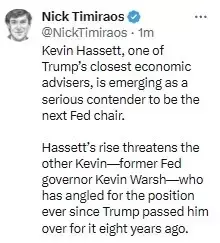
The possibility of Hassett's nomination has already begun to stir discussions among financial analysts and economists. His well-documented inclination to support the policy directions favored by the former President suggests that his tenure, if it materializes, could lead to a more synchronized approach between fiscal and monetary policies. This alignment could be viewed differently across the economic spectrum, potentially drawing both praise for consistency and criticism for a perceived lack of independence. Ultimately, the market's response to such a high-profile appointment will be a critical indicator of confidence in the future trajectory of U.S. monetary policy and the broader economic landscape.
The Ascent of a Key Contender
Kevin Hassett is increasingly seen as a strong candidate for the next Federal Reserve Chair. This development follows a Wall Street Journal report highlighting his emergence as a serious contender. The news has sparked considerable interest, given the critical role of the Fed Chair in shaping monetary policy and influencing global financial stability. Hassett's potential nomination is not only a significant political event but also a crucial economic one, with implications for interest rates, inflation, and market dynamics. His background and past policy stances will be scrutinized as the financial community assesses what his leadership could mean for the future.
The Wall Street Journal's report underscores that Hassett met with former President Trump in June to discuss the position. This meeting is particularly telling, as it suggests that Hassett has gained the attention and, potentially, the favor of the former president, who holds considerable sway in the selection process. Observers note that Hassett’s policy views often align closely with those of the former administration, leading to speculation that his appointment might ensure a Federal Reserve that is more amenable to executive influence. Such a dynamic could lead to a swift and potentially unpredictable shift in monetary policy, making markets attentive to any further indications of his impending nomination and the implications for both domestic and international financial systems.
Market Repercussions and Policy Implications
The potential appointment of Kevin Hassett to lead the Federal Reserve could trigger varied responses across financial markets. Speculation centers on how his leadership might diverge from traditional Fed independence, particularly given his perceived alignment with the former president's economic agenda. Investors and policymakers will be closely watching for signals regarding his approach to interest rates, quantitative easing, and regulatory oversight, all of which could significantly impact asset valuations, currency exchange rates, and overall economic growth projections. The perceived shift in the Fed's stance could lead to volatility as markets adjust to new expectations.
A critical factor in the market's reaction will be Hassett’s flexibility and independence in policy-making. Should he be seen as primarily carrying out the directives of the former president, rather than exercising autonomous judgment based on economic data, it could lead to concerns about the Fed's credibility and its ability to maintain stability during times of economic turbulence. Conversely, some might welcome a more coordinated approach between the executive branch and the central bank, believing it could lead to more decisive and effective economic stimulus or restraint. The real test for markets will come as more concrete details emerge regarding the likelihood of his appointment and, more importantly, the specifics of his economic philosophy and operational strategies should he assume the chair.