Investment Analysis: Costco vs. Amazon - Which Retail Giant Offers a Better Opportunity?
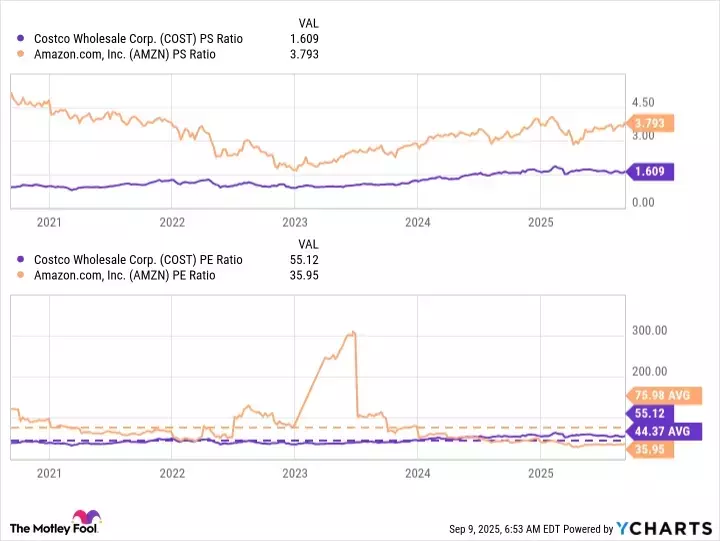
This analysis delves into the investment prospects of two prominent retail corporations, Costco and Amazon, evaluating their business models, growth trajectories, and current market valuations to identify which might offer a superior opportunity for investors. Costco boasts a highly effective membership structure that cultivates strong customer loyalty and a predictable revenue stream. In contrast, Amazon capitalizes on its vast e-commerce presence and rapidly expanding cloud computing and artificial intelligence divisions. The central discussion revolves around their current market assessments, with Amazon appearing to offer a more appealing price point due to its wide array of growth opportunities.

Costco's Enduring Strength: A Model of Loyalty and Consistency
Costco's business strategy is built upon a highly successful membership framework, fostering exceptional customer devotion and generating substantial sales, alongside a steady stream of recurring income that directly boosts its profitability. With a membership exceeding 79 million individuals, Costco's unique approach distinguishes it within the retail sector. Despite the presence of competitors, Costco remains the dominant force in warehouse retail. Its revenue from membership fees, recently adjusted to $65 for standard and $130 for premium tiers, enables the company to maintain remarkably competitive pricing on its merchandise. The company is renowned for its attractively priced offerings, such as the $1.50 hot dog and $4.99 rotisserie chicken, and benefits from strong supplier relationships due to its large purchasing volumes.
The attractive pricing motivates millions of members to frequently shop, maximizing the value of their annual memberships. Costco consistently achieves high membership renewal rates, reporting 92.7% in the U.S. and Canada and 90.2% internationally in its most recent fiscal quarter. While its core retail model has largely remained unchanged for decades, Costco has successfully embraced innovation, particularly in e-commerce. By focusing on in-store pickup for bulky items, the company has integrated its e-commerce operations effectively with its warehouse format. E-commerce sales saw a 14.8% increase in the third quarter, contributing to an overall revenue growth of 8.2%. Additionally, Costco has been highly effective in promoting its premium membership, which, despite representing 47% of total members, accounts for 73% of sales. These members enjoy extra benefits, including 2% cash back and exclusive weekend shopping hours, contributing to a resilient business model that consistently delivers growth and periodic special dividends.
Amazon's Diverse Empire: Beyond E-commerce
Amazon operates far beyond the scope of a traditional retailer, embodying a multi-faceted business model centered on e-commerce. Its strategic combination of low prices, extensive product selection, and rapid delivery services has secured its formidable position in the market, with an estimated 40% or more of the U.S. e-commerce market share, making it exceptionally difficult for rivals to catch up. The company continuously enhances its online marketplace by introducing new products, brands, and technological advancements, alongside optimizing fulfillment processes to maintain its leading edge. Although artificial intelligence (AI) is a contemporary buzzword often associated with Amazon's cloud services, it has been integral to Amazon's success from its inception, powering recommendation systems and facilitating informed purchasing decisions through sophisticated product comparisons.
Presently, Amazon's AI endeavors extend to generative AI through Amazon Web Services (AWS), its expansive cloud computing division. AWS provides clients with a platform to develop diverse AI applications, utilizing a spectrum of large language models with various customization options. Amazon is not only the leading e-commerce entity in the U.S. but also the global leader in cloud computing, commanding approximately 30% of the market. This segment continues to grow rapidly, with a 17% year-over-year sales increase in the second quarter. Across its entire operations, Amazon reported a 13% sales increase, a remarkable achievement for a company with $670 billion in trailing-12-month sales. CEO Andy Jassy anticipates immense future growth for the AI business, which is already a multi-billion-dollar enterprise experiencing triple-digit growth. Furthermore, Amazon's portfolio includes other significant and competitive ventures, such as advertising and streaming services, solidifying its appeal as a compelling investment opportunity.