Microsoft: The Next Tech Giant to Surpass Nvidia in Market Capitalization?
The Ascent of a Tech Behemoth: Microsoft's Challenge to Nvidia's Reign
Nvidia's AI Dominance and Future Growth Trajectory
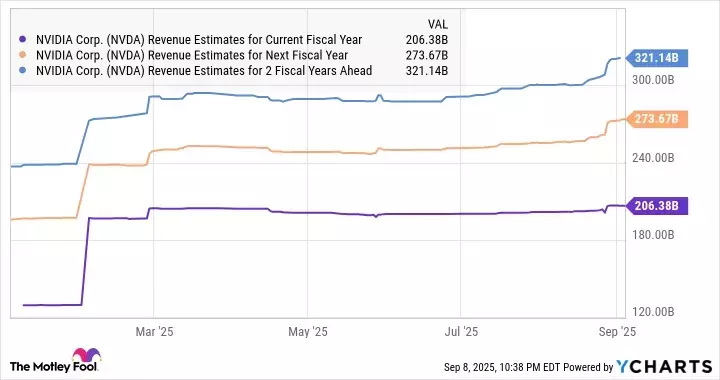
Nvidia has established itself as the world's most valuable enterprise, largely due to its commanding presence in the artificial intelligence (AI) chip sector. Its current market valuation stands at an impressive $4.32 trillion, reflecting sustained, robust expansion despite its already substantial revenue base. Projections indicate that Nvidia's growth trajectory will continue, fueled by significant investments anticipated in AI data centers over the coming half-decade. However, the company's premium valuation—47 times trailing earnings and 25 times sales—could face headwinds from increasing competition in the AI chip arena, coupled with geopolitical complexities such as tariffs and regulatory challenges. Should these factors exert pressure, Nvidia might eventually cede its leading position to another formidable tech entity.

Microsoft's Strategic AI Investments and Revenue Acceleration
Microsoft, a pioneering force in artificial intelligence through its early support for OpenAI, has swiftly integrated OpenAI's innovations across its diverse product portfolio. This strategic foresight has yielded considerable gains. In the fiscal year ending June 30, 2025, Microsoft reported a 15% surge in revenue to $282 billion, with adjusted earnings per share climbing 16% to $13.64. All business units demonstrated strong performance, with the Azure cloud division leading the charge, experiencing a 39% year-over-year increase in revenue during the most recent quarter.
The Power of Microsoft's Expanding Revenue Pipeline
Crucially, Microsoft's revenue pipeline is expanding at an even faster rate than its actual revenue. Commercial bookings soared by 37% to over $100 billion, driven by robust demand for Azure cloud services and Microsoft 365 productivity tools. This influx of new contracts has pushed the company's remaining performance obligations (RPO) to an astounding $368 billion, a 37% increase from the prior year. RPO signifies the total value of future contract fulfillments, and its accelerated growth suggests a potential intensification of Microsoft's top-line expansion moving forward. The burgeoning cloud AI market is expected to further enhance this revenue pipeline.
Unleashing Azure's Potential in the Cloud AI Market
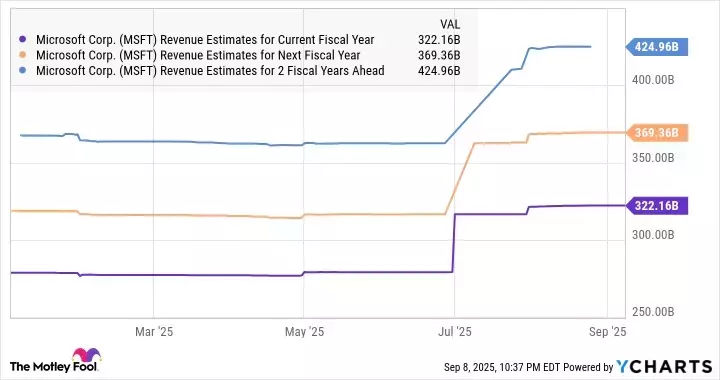
Last quarter, Microsoft's Azure and other cloud revenues grew by 39%. This figure could have been higher, but the demand for the company's AI cloud services currently outstrips supply, prompting Microsoft to rapidly expand its data center capacity. The Azure cloud business alone generated $75 billion in revenue in fiscal 2025, indicating vast room for future growth, supported by the substantial contracted backlog. With the cloud-based AI services market projected to expand at nearly 40% annually throughout the decade, Microsoft's aggressive investments in AI-centric data centers are strategically positioned to capture this opportunity. Increased data center capacity should enable Microsoft to accelerate revenue growth significantly over the next five years, with analysts anticipating a mid-teens growth rate for the company's top line, reaching approximately $425 billion by fiscal year 2028.
Microsoft's Path to Overtaking Nvidia's Valuation
Even if Microsoft maintains a 15% annual growth rate beyond fiscal 2028, its revenue could reach $562 billion by the end of the decade. Currently, Microsoft holds the position of the world's second-largest company, with a market capitalization of $3.72 trillion, which is 16% lower than Nvidia's. Importantly, Microsoft trades at a much lower price-to-sales ratio of 13 times, half of Nvidia's. It is plausible that Microsoft's sales multiple will hold steady, or even increase, as its growth rate improves. Even at a slightly discounted 10 times sales multiple in 2030, based on a $562 billion revenue, Microsoft's market cap could climb to $5.6 trillion. Given that Nvidia's top-line growth is projected to decelerate, potentially leading to a reduction in its high valuation premium, the prospect of Microsoft surpassing Nvidia as the world's most valuable company by 2030 is certainly within the realm of possibility.