AI Integration: A Catalyst for Corporate Outperformance, Says Morgan Stanley
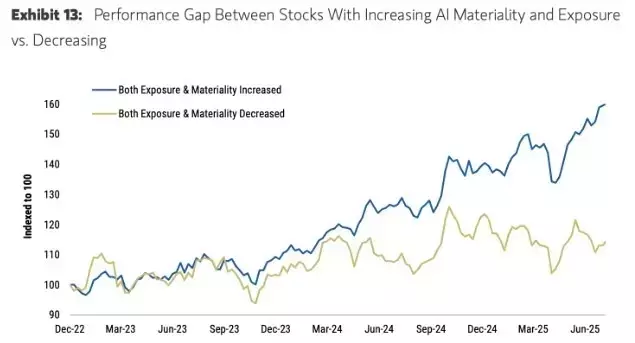
A recent report from Morgan Stanley highlights a compelling trend in the corporate world: businesses that have embraced artificial intelligence are experiencing a noticeable lead in financial metrics. This distinct advantage is apparent in both their earnings trajectory and their stock market returns, suggesting that proactive engagement with AI technologies is directly correlated with robust financial health and market leadership. The gap between those companies leveraging AI and those lagging in adoption is progressively widening, a pattern Morgan Stanley anticipates will persist.

The Growing Impact of Artificial Intelligence on Corporate Success
According to Morgan Stanley's latest Artificial Intelligence Adopter Survey, corporate investment in AI is undeniably yielding substantial returns, with organizations that were quick to integrate these technologies now showing superior financial outcomes. This shift is not merely superficial; firms actively utilizing AI are seeing improved earnings forecasts and stronger share price movements. The integration of AI is rapidly expanding across key sectors, most notably within financial services, real estate, and consumer durables, marking a pivotal transformation in operational strategies and market positioning.
The deep dive into AI's growing influence across industries reveals that its integration is accelerating at an impressive rate. In the financial sector, for instance, the proportion of insurance companies deploying AI surged from 48% to 71% in just a few months, with broader financial services adoption reaching 73%. This widespread implementation is primarily aimed at refining customer service protocols and fortifying compliance frameworks, areas identified as prime opportunities for both revenue enhancement and cost reduction. Similarly, the consumer durables and apparel segment has witnessed AI adoption skyrocket from 20% to 44%, largely propelled by initiatives to optimize supply chain management. Major retail giants are leveraging AI to achieve more efficient inventory control, demonstrating AI's capacity to deliver significant operational improvements. Within real estate, approximately one-third of REITs now have increased exposure to AI compared to the start of the year. Automation, driven by AI, is boosting productivity across various facets of the real estate business, including leasing and property management. A substantial portion of tasks within brokerage and services are being automated, underscoring AI's transformative potential in streamlining complex operations.
Early AI Adoption: A Clear Indicator of Market Leadership
The analysis from Morgan Stanley consistently demonstrates that companies making AI a fundamental component of their business strategies are enjoying enhanced earnings revisions and are significantly outperforming their peers. This growing disparity between AI-forward enterprises and those that are slower to adapt is becoming increasingly pronounced, a trend that Morgan Stanley projects will continue to define market dynamics. The embrace of AI is thus emerging as a critical differentiator for sustained success and competitive advantage.
The detailed findings from Morgan Stanley's report underscore that companies where artificial intelligence has become an integral part of their operations are consistently experiencing more favorable earnings revisions and demonstrating superior relative performance in the market. This burgeoning gap between companies that are leading the charge in AI adoption and those that are lagging behind is becoming more pronounced, a trajectory that Morgan Stanley analysts expect to persist in the foreseeable future. This suggests that proactive investment in AI is not merely an incremental improvement but a fundamental driver of competitive differentiation and financial superiority. The ability to harness AI for operational efficiencies, customer engagement, and strategic decision-making is creating a clear dividing line in market success. As AI technologies evolve and become more accessible, the pressure on all businesses to adopt and effectively integrate AI will intensify, further widening the performance chasm between innovators and those resistant to change. Ultimately, the report posits that AI leadership is becoming synonymous with market leadership, signifying a pivotal shift in the corporate landscape.