AUDUSD Experiences Sharp Reversals, Bears Maintain Short-Term Dominance
The AUDUSD currency pair has recently undergone considerable volatility, experiencing a rapid shift from upward momentum to a bearish trend. After reaching its peak in November following a significant surge on Friday, the pair saw an abrupt reversal. A sharp decline on Tuesday pushed the exchange rate below critical technical levels, signaling a change in market sentiment. Despite a brief rally sparked by unforeseen news, the prevailing bearish forces quickly reasserted their control. This article delves into the factors contributing to these fluctuations and provides insights into potential future movements.
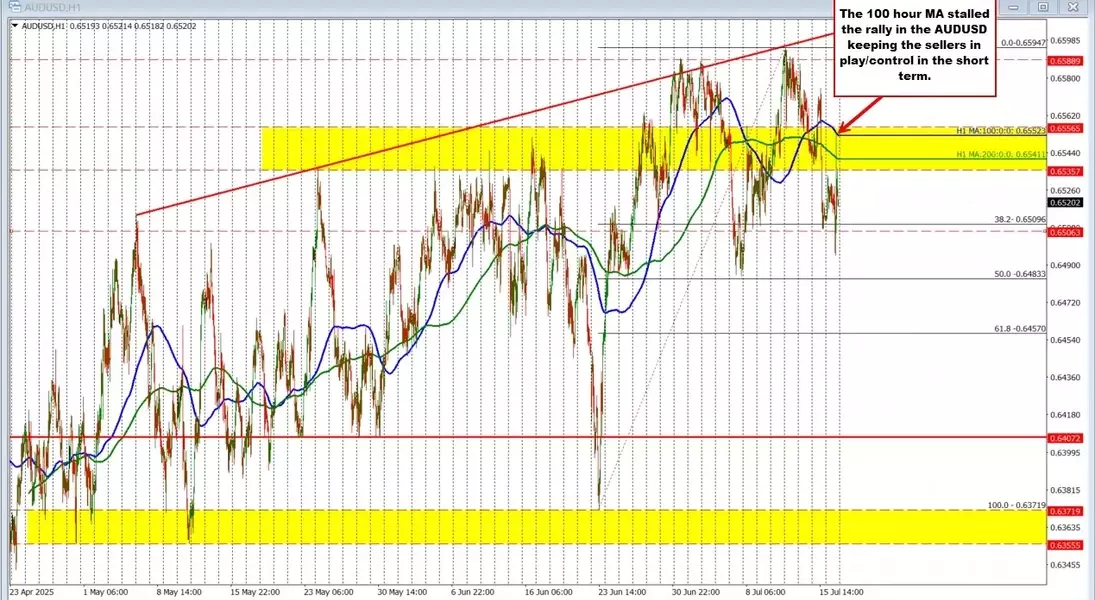
Since April, the AUDUSD pair has been characterized by its dynamic price swings. Initially, the general trend indicated an upward bias, culminating in Friday’s impressive surge, which propelled the pair to its highest valuation since November. This strong performance suggested a robust bullish sentiment among market participants. However, the market’s script flipped dramatically, demonstrating the inherent unpredictability of currency trading.
The shift became evident with Tuesday’s significant downturn. The price action rapidly depreciated, falling to the 38.2% Fibonacci retracement level of the June rally. This technical support level, often closely watched by traders, initially provided a temporary floor. Following a bounce during the Asian trading session, renewed selling pressure emerged in the early U.S. session. This renewed weakness drove the pair further down, breaching the crucial Fibonacci level and hitting a low of 0.6495, indicating a strong bearish impulse.
A sudden, unexpected news event briefly disrupted this downward trajectory, causing the AUDUSD to surge. The pair rallied past the 200-hour moving average, reaching 0.6541. However, this bullish momentum proved short-lived, with buying interest dissipating just shy of the 100-hour moving average at 0.6554. As quickly as the rally began, it reversed course once the initial impact of the news faded and the market digested the information, leading to another sharp decline.
Currently, the AUDUSD is trading beneath both its 100-hour and 200-hour moving averages. Furthermore, it has slipped below a significant swing zone, ranging from 0.6535 to 0.65565. This technical positioning strongly suggests that the short-term market bias remains bearish. Traders are now keenly observing specific price points for further directional cues.
Looking ahead, a decisive break and sustained trading below 0.6509 would likely pave the way for further declines. Such a move could expose additional support levels at 0.6495 and 0.6483, which correspond to the 50% Fibonacci retracement and last week’s lows, respectively. Conversely, a successful reclaim of the 200-hour moving average could signal a potential shift in market tone. However, as it stands, sellers continue to exert control over the AUDUSD’s price action, and careful observation of the 0.6509 threshold is paramount for anticipating the pair's next significant move.