Canadian Job Growth Impacts USDCAD Exchange Rate
The Canadian dollar strengthened against its American counterpart following the release of robust employment data from Canada. This economic indicator revealed significant job creation, particularly in part-time sectors, leading to a notable reduction in the unemployment rate. While average hourly wages saw a modest slowdown, the overall health of the labor market appears resilient. This positive news spurred an initial decline in the USDCAD exchange rate, but the currency pair quickly found a critical support level, signaling a potential stabilization or reversal in its short-term trajectory. Traders are now closely monitoring key technical indicators to determine the next significant move for the pair.
On July 11, 2025, the Canadian employment report for June showcased a stronger-than-expected increase in total employment, adding 83,100 jobs. This figure far surpassed the anticipated zero growth and the modest 8,800 jobs gained in the preceding month. The surge was primarily fueled by part-time positions, which accounted for 69,500 new jobs, while full-time employment also saw a gain of 13,500. Consequently, the unemployment rate declined to 6.9% from 7.0%, outperforming the 7.1% forecast. The participation rate also edged up to 65.4% from 65.3%, further underscoring a buoyant labor market. However, a slight easing was observed in the average hourly wages for permanent workers, which registered a year-over-year growth of 3.2%, down from 3.5% previously.
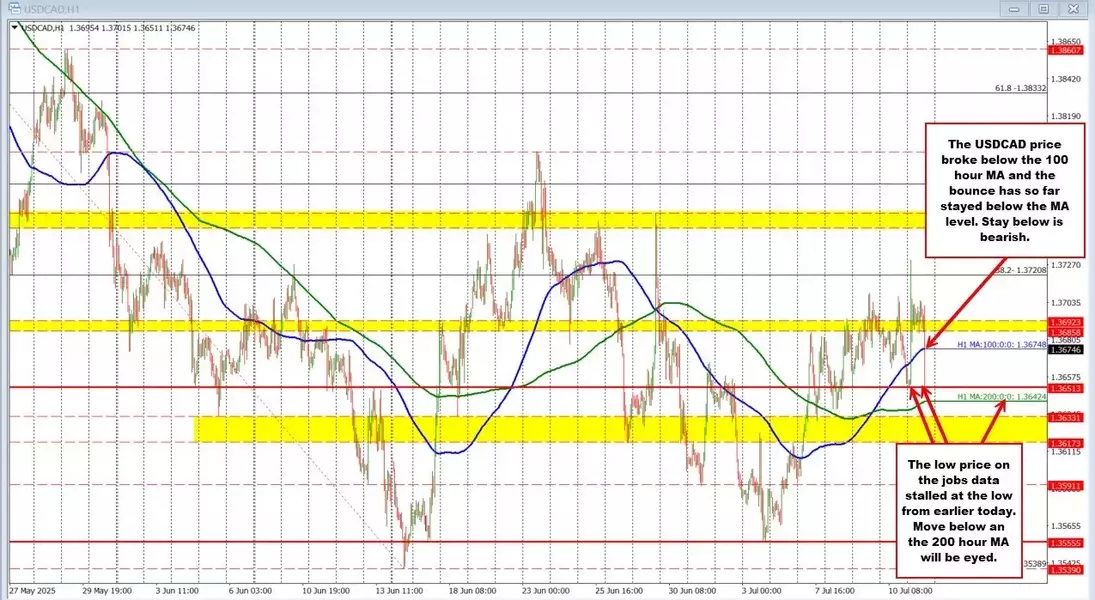
Immediately following the release of these positive Canadian job figures, the USDCAD pair experienced a downward movement, falling from 1.3686 to a session low of 1.3651. This level briefly breached the earlier Asian session low of 1.3652. However, this dip was short-lived, as market participants quickly intervened, providing buying pressure that prevented a further decline. The currency pair subsequently rebounded, ascending to a high of 1.3673, which positioned it close to its rising 100-hour moving average, a key technical resistance point currently situated at 1.3675. This swift recovery from the support level suggests a strong underlying demand for the Canadian dollar, despite the initial volatility.
For the USDCAD pair, the sustained trading above the 100-hour moving average is now a critical factor. A decisive move above this technical benchmark would negate the bearish sentiment that often follows strong economic data from the opposing currency and could signal an upward continuation. Conversely, if the pair fails to maintain its position above this level and resumes its downward trend, it could test the day's low and potentially move towards the rising 200-hour moving average, currently at 1.36424, which serves as another crucial support. The interplay between these technical levels and upcoming economic releases will shape the pair's near-term direction, underscoring the dynamic nature of currency markets.
The recent performance of the USDCAD exchange rate underscores the immediate and often profound influence of macroeconomic data on currency market dynamics. The significant job growth in Canada initially weakened the pair, reflecting the Canadian dollar's strengthening. However, the subsequent quick recovery from a key support level highlights underlying market resilience and the importance of technical indicators in guiding trading decisions. The ongoing analysis of these elements remains crucial for understanding future movements.