Eurozone's Current Account Surges in May, Driven by Trade and Services
The Eurozone's current account balance experienced a notable uplift in May, soaring to €32.3 billion. This marked improvement from April's €19.3 billion figure signals a strengthening in the region's external economic health. The positive trajectory is largely attributable to strong performances in both the trade of goods and services, alongside a healthy contribution from primary income. Although secondary income registered a deficit, the overall balance highlights the Eurozone's increasing capacity to accumulate foreign assets.
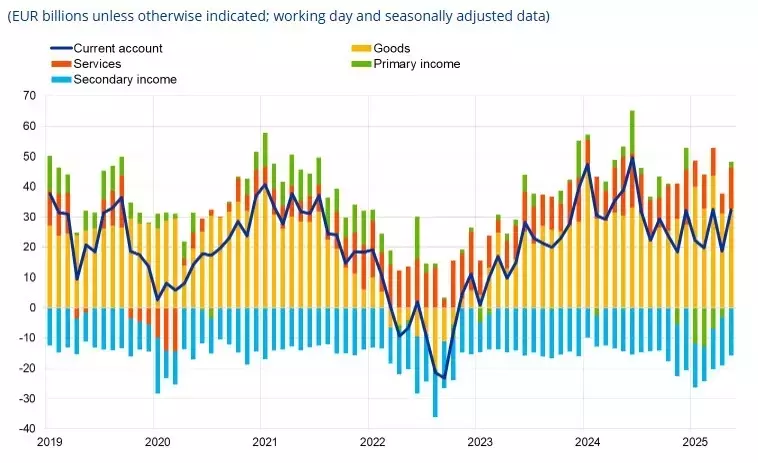
New data released by the European Central Bank (ECB) on July 18, 2025, confirmed this substantial increase in the Eurozone's current account for May. This key economic indicator, which reflects a country's or bloc's total transactions with the rest of the world, registered a significant expansion compared to the prior month.
A closer examination of the components reveals the underlying drivers of this growth. The balance of goods exhibited a considerable surplus of €33 billion, indicating that the Eurozone exported significantly more goods than it imported during May. Similarly, the services sector contributed a robust €13 billion surplus, demonstrating the strength and competitiveness of the Eurozone's service industries in the global market.
Furthermore, primary income, which includes earnings from cross-border investments and compensation of employees, added another €2 billion to the positive balance. This segment reflects the returns on the Eurozone's investments abroad and the income generated by its residents working overseas. While these positive contributions were substantial, they were partially counteracted by a deficit of €16 billion in secondary income. Secondary income typically involves current transfers without a direct exchange of goods or services, such as remittances or foreign aid.
This upward trend in the current account balance underscores the Eurozone's enhanced external position. The sustained surpluses in goods and services trade are pivotal in demonstrating the competitiveness of Eurozone businesses and the resilience of its economic framework within the international arena. This robust performance is a positive sign for the region's financial stability and its capacity for future growth.