Federal Reserve's Interest Rate Policy: An Analysis of Potential Impacts and Political Discourse
The discourse surrounding the Federal Reserve's interest rate strategy is often complex, especially when juxtaposed with political demands. This article aims to clarify the implications of potential rate adjustments, focusing on how seemingly beneficial cuts could paradoxically lead to adverse economic outcomes. It underscores the importance of a nuanced understanding of monetary policy's interaction with broader economic forces.
Understanding the Dynamics of Interest Rates: A Detailed Analysis
On a recent Friday, July 18, 2025, former President Donald Trump voiced renewed criticism regarding the Federal Reserve's maintenance of steady interest rates. His concerns, articulated during an unspecified public address, centered on the detrimental effect of elevated rates on the housing market, specifically noting the challenges faced by young individuals in securing homeownership. Trump advocated for a drastic reduction in the federal funds rate to 1%.
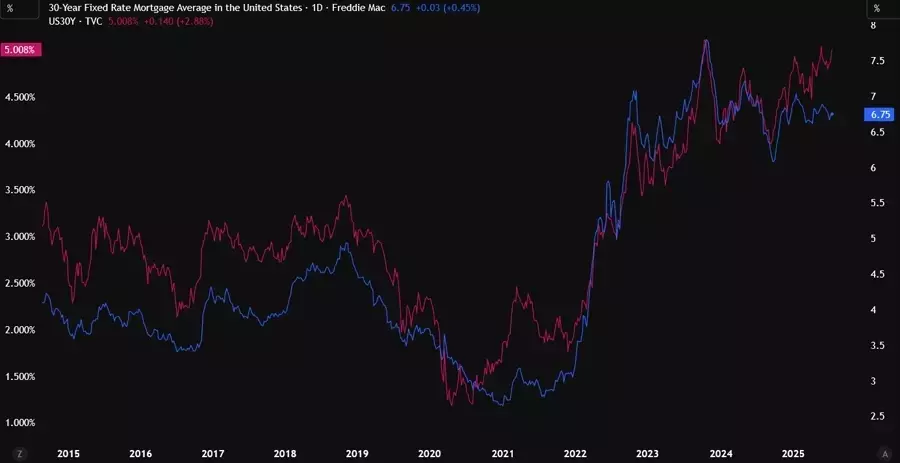
The intricate connection between the 30-year Treasury rates and mortgage rates is fundamental to understanding this economic landscape. Long-term rates are not merely a reflection of current central bank policy but also a forward-looking projection of future short-term rates, significantly influenced by inflation risk premiums. Therefore, while the Federal Reserve directly controls short-term rates, their influence on long-term rates is mediated by market expectations and underlying economic conditions.
Economists and market analysts argue that an abrupt reduction of the federal funds rate to 1% by the Federal Reserve, especially within a climate characterized by tariff-induced price increases and expansionary fiscal policies, could trigger an unintended consequence: a surge in long-term interest rates. This counterintuitive outcome would stem from heightened inflation expectations, leading to an increase in borrowing costs for mortgages and potentially suffocating the housing market even further. Such a scenario could compel the Federal Reserve to undertake more aggressive tightening measures in the future, risking an economic downturn.
Navigating the Economic Noise: A Critical Perspective
From a journalistic and analytical perspective, the ongoing political commentary surrounding the Federal Reserve's decisions often serves as a distraction rather than a constructive contribution to economic policy discussions. While political figures are entitled to express their views, the complexities of monetary policy, particularly its long-term implications, require a more sober and data-driven approach. For investors and traders, the prudent course of action is to filter out such "noise" and focus on fundamental economic indicators and the Federal Reserve's stated objectives and analyses. The true impact of monetary policy stems from its careful calibration to achieve price stability and maximum employment, not from immediate political gratification. Therefore, a critical assessment of all economic pronouncements, irrespective of their source, is paramount to making informed decisions in the dynamic global market.