Oracle's AI Ambitions: Can it Rival Nvidia's Market Dominance?
Nvidia has indisputably become a frontrunner in the artificial intelligence sector, achieving unprecedented revenue and a phenomenal increase in its stock valuation. Yet, the investment community is actively searching for the next breakthrough company to capitalize on the AI boom. Oracle, having recently projected astonishing growth, is now under consideration as a potential successor to Nvidia's AI triumph. This examination delves into the shared characteristics of these technology behemoths and assesses Oracle's future outlook in the rapidly expanding AI infrastructure arena.

Oracle's Bold AI Forecast: A Deep Dive into its Growth Trajectory
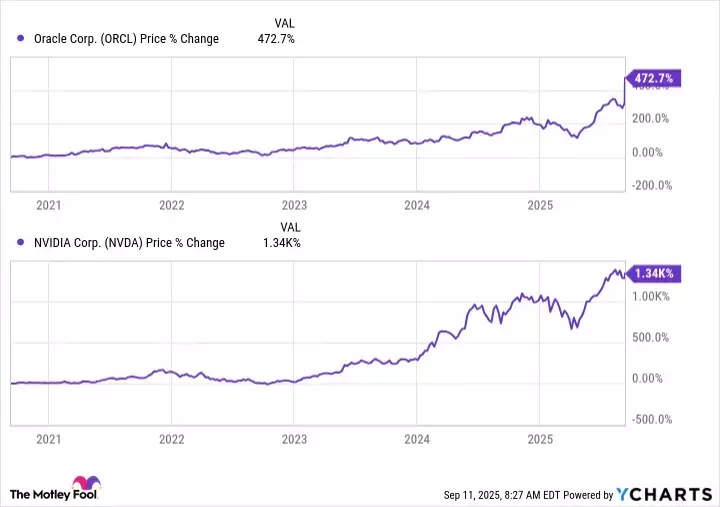
In a significant market development, Oracle recently presented an ambitious financial projection, predicting a massive expansion in its cloud infrastructure revenue. The company anticipates an increase from $18 billion in the current fiscal year to an astounding $144 billion within the next four years. This forward-looking statement, announced earlier this week, sent Oracle's stock soaring by an impressive 35% in a single trading session, immediately capturing the attention of investors worldwide.
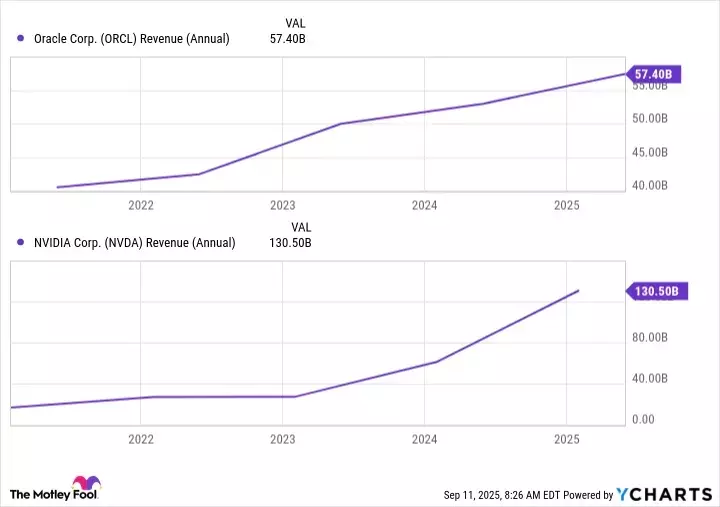
This surge in investor confidence stems from Oracle's strategic positioning within the AI revolution. Similar to Nvidia, which has been instrumental in providing the foundational hardware for AI development through its graphics processing units (GPUs), Oracle has recognized and invested heavily in the AI opportunity. While Nvidia's early success was largely due to the immediate demand for its advanced chips in AI development, Oracle focused on enhancing its cloud infrastructure and integrating AI capabilities with its robust database platform. These parallel, yet distinct, strategies have both fueled substantial revenue growth for both companies over recent years.
The market for AI infrastructure is projected to reach an astronomical $4 trillion over the next five years, according to Nvidia. Major tech players, including Meta Platforms and Alphabet, have already signaled increased capital expenditures to bolster their AI initiatives, validating the immense potential of this sector. This broader industry trend creates a fertile ground for Oracle's anticipated growth in cloud infrastructure. Oracle foresees securing several multi-billion dollar contracts in the coming months, further solidifying its position in this competitive landscape.
Despite facing competition from other cloud service providers, much like Nvidia navigates a crowded field of chip designers, Oracle's unique blend of database expertise and AI integration distinguishes its offerings. This holistic approach, combined with a comprehensive ecosystem of related services, positions Oracle to potentially replicate Nvidia's market leadership. Although Oracle's current valuation, trading at 48 times forward earnings estimates, appears higher than Nvidia's 39 times, this metric primarily reflects short-term projections and may not fully capture Oracle's long-term growth potential. Should Oracle's shares triple from their current levels, its market capitalization would approach $2.7 trillion, still comfortably within the range of other tech giants in the trillion-dollar club.
In essence, Oracle's methodical business development, deeply rooted in decades of technological advancement, coupled with its forward-thinking embrace of AI, strongly suggests that it could indeed emerge as the next Nvidia, delivering substantial and long-lasting gains to its investors.
The meteoric rise of artificial intelligence has reshaped the technological and investment landscapes, creating unprecedented opportunities for companies at the forefront of this innovation. The narrative of Nvidia's journey to AI dominance serves as a compelling blueprint, demonstrating how early vision and strategic adaptation can lead to exponential growth. Oracle's recent announcements and market performance suggest a similar trajectory, highlighting the critical importance of foundational infrastructure in supporting the burgeoning AI ecosystem. This presents a powerful lesson for both established enterprises and nascent startups: identifying and actively pursuing the core enablers of new technological eras is paramount for sustained success. Furthermore, it underscores the dynamic nature of market leadership, where incumbents can be challenged and new leaders can emerge by effectively anticipating and fulfilling evolving technological demands. The ongoing evolution of AI promises continued disruption and innovation, making the ability to adapt and innovate a key determinant of future market leaders.