USDJPY Technical Analysis: Retreat Below Key Indicators Signals Potential Downside
The USDJPY currency pair has experienced a notable decline, retreating beneath the critical 100-hour moving average and the 38.2% Fibonacci retracement level. This recent movement suggests a bearish sentiment in the immediate term, frustrating bullish investors who had previously sought to propel the pair higher during the U.S. trading session. The market's attention is now directed towards potential lower targets, specifically the 200-hour moving average and the 50% retracement mark, as selling pressure intensifies. The current positioning between the 100-hour and 200-hour moving averages implies a more neutral overall technical stance, yet the break below the 100-hour MA underscores a short-term bearish bias.
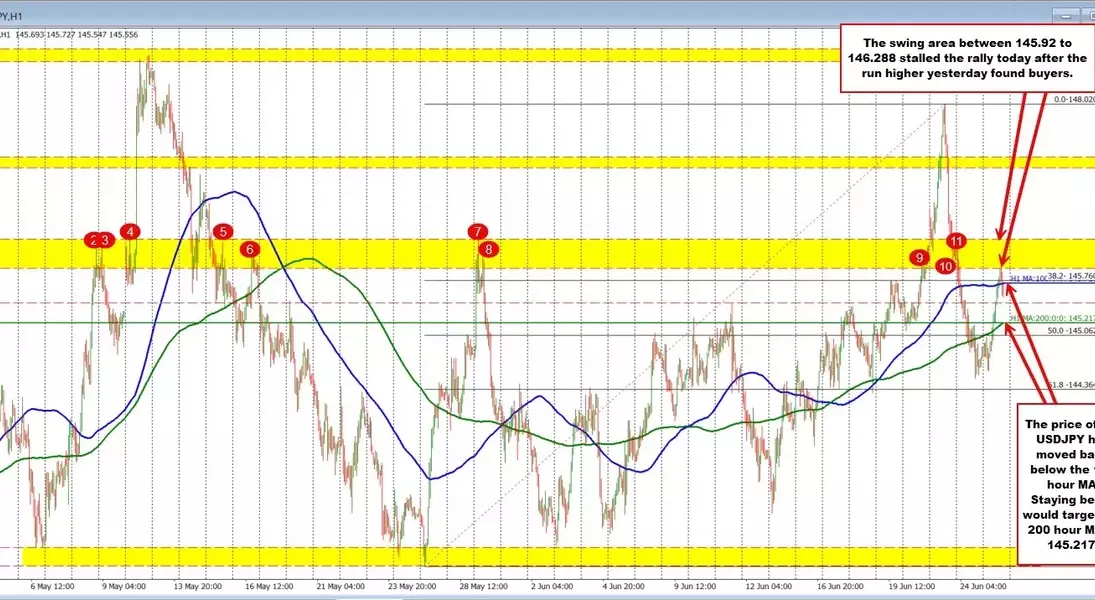
Earlier in the trading day, after an initial upward push, the USDJPY's advance faltered near the lower boundary of a crucial swing zone, bounded by 145.92 and 146.288. This level proved to be a strong resistance point, where sellers effectively reasserted their dominance, preventing further ascent. The failure of buyers to sustain momentum above key technical barriers has reinforced the current downtrend, leading to the re-evaluation of immediate price expectations. The inability to hold ground above these significant indicators signals a weakening of bullish resolve and a strengthening of bearish control.
Given the confirmed slip below the 100-hour moving average, market participants are now scrutinizing lower support thresholds. The 200-hour moving average, situated at 145.217, represents the immediate significant downside target. Should this level be breached, the 50% retracement level at 145.06 will become the next crucial support to watch. As long as the pair remains beneath the 100-hour moving average, sellers are expected to maintain their advantage, keeping downward pressure on the currency pair. Conversely, any sustained move above 145.76 would alleviate immediate bearish pressure.
Looking ahead, the technical landscape for USDJPY suggests that maintaining levels below 145.76 will continue to exert downward pressure on the currency pair in the near term. Traders and analysts will closely monitor these key technical levels for further cues on the pair's trajectory, with potential for continued depreciation if current support levels fail to hold.