Asia's Economic Pulse: RBNZ Decision and Chinese Inflation Data
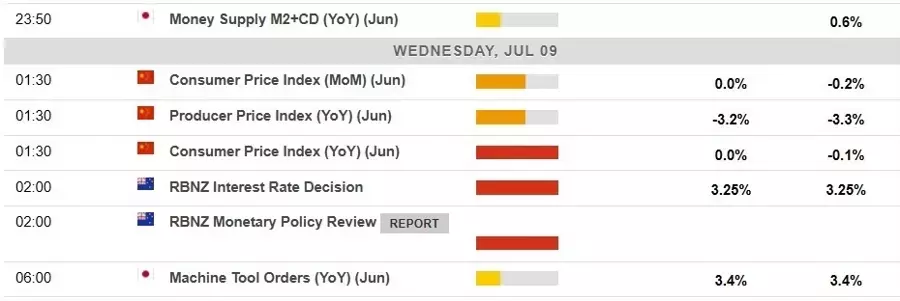
The upcoming economic calendar for Asia on Wednesday, July 9, 2025, presents a crucial juncture for market observers, with significant events poised to influence regional and global financial dynamics. The Reserve Bank of New Zealand's (RBNZ) interest rate decision stands at the forefront, alongside the eagerly awaited inflation figures from China. These events are not merely isolated data points but rather integral components that will collectively shape the narrative of economic stability and growth in the Asia-Pacific.
RBNZ's Policy Stance and Market Expectations
The Reserve Bank of New Zealand is widely projected to keep its cash rate unchanged at its upcoming meeting. This consensus view is bolstered by various analytical forecasts, including those from leading financial institutions, which suggest a continuation of the current monetary policy settings. The anticipated stability in New Zealand's interest rates reflects a careful assessment of domestic economic conditions and global financial headwinds. This move is consistent with a prudent approach to monetary management, aiming to foster sustained economic recovery without exacerbating inflationary pressures or compromising financial stability.
However, the recent decision by the Reserve Bank of Australia (RBA) to unexpectedly maintain its interest rates serves as a stark reminder of the unpredictable nature of central bank actions. Despite strong market expectations and a near-universal consensus among analysts for a rate reduction, the RBA chose a different path. This divergence highlights the importance of maintaining an open mind and considering a spectrum of well-reasoned arguments, even those that run counter to prevailing market sentiment. The RBA's decision underscores that central banks operate within complex and evolving economic landscapes, where unforeseen factors or a re-evaluation of policy objectives can lead to outcomes that defy conventional wisdom. Therefore, while the RBNZ is expected to hold, the market remains keenly aware of potential surprises.
China's Inflation Data and Regional Economic Implications
Beyond the RBNZ's policy announcement, the release of China's inflation data will undoubtedly capture significant attention. As the world's second-largest economy, China's inflationary trends have profound implications for global trade, supply chains, and commodity markets. The forthcoming Consumer Price Index (CPI) and Producer Price Index (PPI) figures will offer valuable insights into the health of China's economy, reflecting both domestic demand pressures and the cost of production. These statistics are closely watched for signs of either overheating or deflationary risks, both of which could trigger significant policy responses from Beijing.
The interplay between monetary policy decisions in countries like New Zealand and economic indicators from China creates a complex tapestry of interdependencies across the Asian economic landscape. A stable interest rate environment in New Zealand, combined with a clearer picture of China's inflation, will provide investors and policymakers with a more comprehensive understanding of the region's economic trajectory. The data from these two economies will serve as critical benchmarks for assessing economic vitality, guiding investment strategies, and informing future policy adjustments across the broader Asia-Pacific region. The overall market will scrutinize these releases for any clues regarding the future direction of economic activity and financial market stability.