AUDUSD: Navigating Volatility as RBA Holds Rates
Recent market movements have seen the AUDUSD pair exhibit notable fluctuations, primarily driven by central bank actions and economic indicators. The Reserve Bank of Australia's recent decision to keep its cash rate unchanged, diverging from some market expectations, has played a pivotal role in strengthening the Australian dollar against its U.S. counterpart. This unexpected stance by the RBA signals a cautious approach, as the bank awaits the release of upcoming quarterly consumer price index data to inform its future policy decisions. Concurrently, the U.S. dollar has experienced mixed fortunes. While a stronger-than-anticipated non-farm payroll report initially bolstered the greenback, the accompanying softer wage growth figures tempered its advance, preventing a more sustained rally. This interplay of central bank policies and employment data underscores the complex factors influencing the AUDUSD exchange rate, with global growth prospects continuing to provide an underlying supportive trend for the pair.
Last Thursday's U.S. non-farm payroll report, which surpassed forecasts, initiated a hawkish re-evaluation of interest rate expectations within the U.S. market. This re-evaluation, however, was mitigated by the less robust wage growth component of the report, which prevented the U.S. dollar from achieving more substantial and enduring gains. This nuance in the U.S. economic data highlights the delicate balance the Federal Reserve must strike in its monetary policy considerations.
Simultaneously, the Reserve Bank of Australia's recent policy meeting concluded with an unexpected decision to hold the cash rate steady. The RBA explicitly stated its intention to scrutinize the next quarterly inflation data before contemplating any adjustments to its monetary policy. This patient approach by the RBA suggests a desire to thoroughly assess inflationary pressures and their persistence before making any moves that could impact the Australian economy.
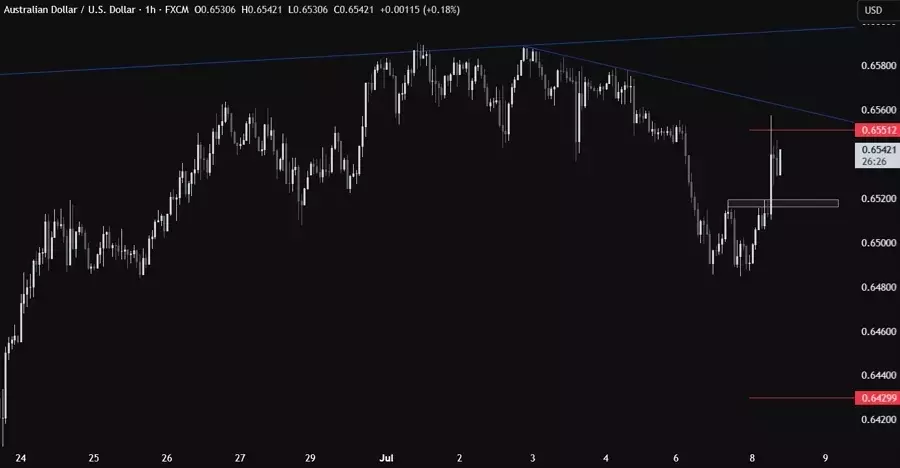
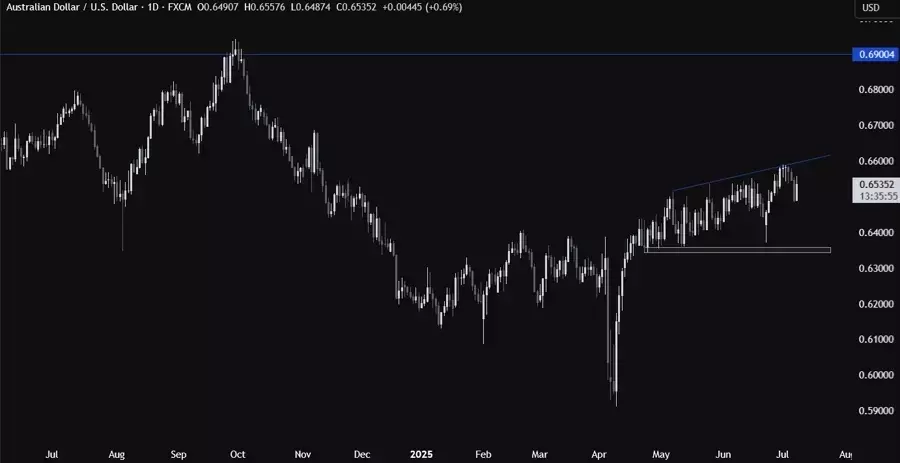
Looking at the technical landscape, the AUDUSD daily chart reveals the pair trading within a broadening wedge pattern. The upper boundary of this wedge has historically acted as a resistance level, while the 0.6350 price area has provided consistent support. While the recent non-farm payroll figures may have temporarily capped the AUDUSD's upward momentum, a sustained depreciation of the Australian dollar would likely necessitate stronger U.S. inflation figures, pushing the pair towards the 0.6350 support zone. On an hourly timeframe, the pair has already approached the upper limits of its average daily trading range, suggesting that significant further movement may be limited for the current trading session. A minor downward trendline is also observed, where selling pressure may emerge, potentially targeting a descent towards the 0.6350 support. Conversely, buying interest is anticipated around the 0.6520 support level, with traders looking for an opportunity to push the price beyond the aforementioned trendline.
In summary, the AUDUSD pair remains highly sensitive to both Australian and U.S. economic releases and central bank guidance. The RBA's commitment to evaluating future inflation data before adjusting rates, combined with the nuanced implications of U.S. employment statistics, continues to shape the currency pair's trajectory. Market participants are closely watching for subsequent economic indicators and any shifts in monetary policy rhetoric that could influence the pair's short-term and long-term outlooks.