EIA Oil Inventory Data Release and Market Impact
Navigating the Volatile Waves of Crude: Anticipating EIA's Latest Inventory Signals
Upcoming EIA Data: Key Market Expectations for Oil Inventories
The Energy Information Administration is on the verge of publishing its latest weekly inventory figures, a pivotal moment for oil markets. Current projections suggest a reduction in crude oil reserves, with estimates indicating a decrease of 0.552 million barrels, a notable shift from the previous week's increase of 7.07 million barrels. Conversely, expectations point to an accumulation in refined products: distillate stocks are forecasted to rise by 0.199 million barrels, and gasoline inventories are projected to grow by 0.952 million barrels. Cushing's storage is anticipated to see an increase of 0.464 million barrels, mirroring the prior period's unchanged level.
Recent Private Data Reveals Shifting Oil Dynamics
Preliminary data from private sources, unveiled in the preceding day, offered an early glimpse into the evolving inventory landscape. These figures indicated an expansion across key categories: crude oil reserves reportedly swelled by 0.8 million barrels, distillate stockpiles increased by 1.8 million barrels, and gasoline inventories saw a substantial rise of 1.9 million barrels. Interestingly, Cushing, a critical storage hub, registered a modest draw of 0.1 million barrels, providing a mixed signal ahead of the official government release.
Crude Oil Market Reaction: Price Movements and Technical Levels to Watch
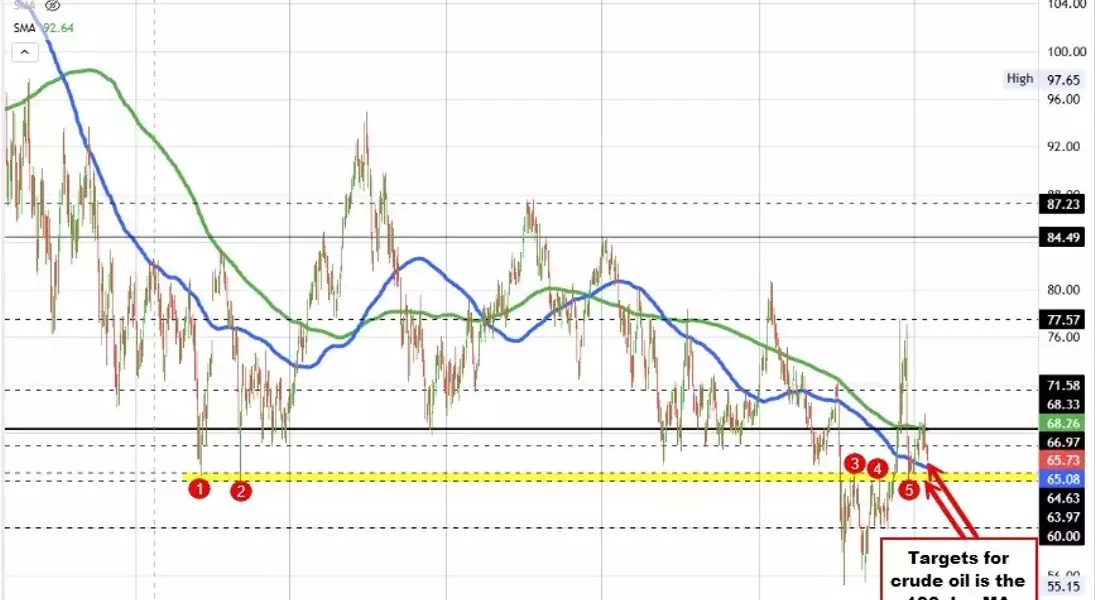
In response to these market influences, crude oil prices are currently trading lower, registering a decline of $0.80 to reach $65.70 per barrel. The commodity's price oscillated, touching highs near $67 before retreating towards lows around $65.60. From a technical standpoint, the 100-day moving average, positioned at $65.08, represents a crucial support level. A decisive break below this point could amplify bearish momentum. Furthermore, a significant price range between $63.97 and $64.63, denoted by highlighted zones on market charts, serves as a key swing area. Penetrating below this range would place crude oil at the lower extreme for the current year, nearing its 2025 nadir of approximately $55.15.