Emerging Markets Debt: A Strategic Outlook Amidst Global Uncertainty
In the first quarter of 2025, emerging markets (EM) debt demonstrated resilience despite rising uncertainties stemming from U.S. trade policies and geopolitical tensions. The performance was bolstered by favorable fundamentals in EM countries alongside declining U.S. Treasury yields and a weaker dollar. While maintaining a positive long-term outlook, analysts have become more cautious in the short term due to potential risks associated with global trade shocks. This article delves into the strategic positioning across various currencies and rates, highlighting key adjustments made to mitigate downside risks.
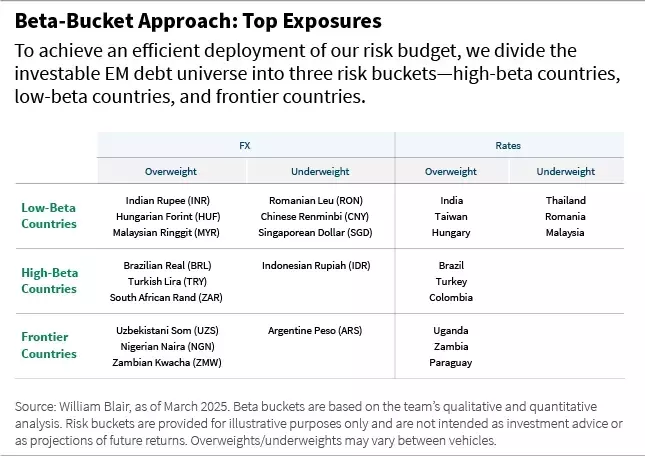
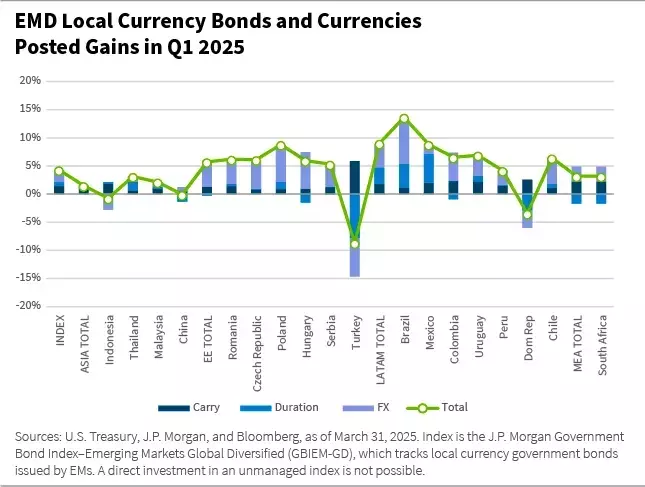
As trade tensions escalated and U.S. policy introduced fresh uncertainty, portfolio managers reassessed their stance on high-, low-, and frontier-beta currencies and rates. Initially, the J.P. Morgan Government Bond Index–Emerging Markets Global Diversified (GBIEM-GD) saw a robust return of 4.31%, driven equally by currency gains and local rates. However, concerns about a global trade shock prompted a reduction in net exposure to higher-beta and liquid currencies relative to the U.S. dollar. Analysts anticipate that foreign exchange could serve as a critical relief valve during such shocks.
This anticipated global disturbance differs significantly from previous ones, primarily due to its origin in U.S. policy decisions. It is believed that the United States might experience negative repercussions in terms of growth and inflation, potentially affecting emerging markets differently. Consequently, recent weeks have witnessed strong performances in EM equities and capital outflows from U.S. assets. If risk sentiment remains stable, central banks in emerging markets may find opportunities to cut interest rates without exacerbating currency weakness or inflationary pressures.
Within the realm of liquid currencies, relative value positions are favored due to variations in initial pricing and market conditions, along with exposure to trade dynamics and commodities. In frontier markets, marginal reductions in exposure were achieved through hedging highly exposed and idiosyncratic currencies like the Vietnamese đồng and the Argentine peso. Should global risk conditions deteriorate further, selective hedging via currency forwards rather than bond sales will likely be employed.
The strategy also emphasizes being overweight on duration across emerging and frontier markets, given the expectation that negative growth and inflation shocks will impact bond prices more than spreads or country-risk components. Risk management and diversification remain pivotal in mitigating potential downturns.
Breaking down active positions by beta bucket reveals nuanced strategies. In the low-beta category, India's rupee benefits from declining inflation within the central bank’s target range, supported by liquidity injections. Hungary's forint enjoys an attractive valuation compared to the Polish zloty, while Malaysia's ringgit remains resilient despite external uncertainties. Conversely, Romania's leu faces challenges due to twin deficits and election cycles.
High-beta exposures see reduced directional FX exposure to the dollar, favoring relative value plays within EMs. Brazil's real contrasts with Chile's peso, reflecting differing macroeconomic vulnerabilities. Turkey's local bonds offer compelling yields amid political volatility, whereas South Africa's rand maintains tactical weight based on recent performances.
Frontier markets include out-of-benchmark positions such as Uzbekistan, benefiting from high gold prices and a recovering Russian ruble. Nigeria's naira retains appeal due to open-market-operation bills, though oil price declines pose risks. Zambia's bond position aligns with expectations of further disinflation, while Uganda's local currency assets present attractive real rates. Paraguay enters the portfolio due to strong macro fundamentals and low correlation to global risk factors.
Moving forward, managing risk effectively while capitalizing on opportunities within emerging markets requires a balanced approach. By leveraging derivatives and selective hedges, portfolio managers aim to preserve value amidst shifting global dynamics. The emphasis remains on adapting to evolving conditions and seizing advantageous positions where possible.