Global Markets Respond to RBA's Steady Rate Decision Amidst Shifting Trade Dynamics
In the evolving landscape of global finance, the U.S. dollar exhibits a varied performance against key international currencies as the North American trading day commences. This nuanced behavior emerges against a backdrop of significant central bank decisions and escalating international trade tensions. The Reserve Bank of Australia's (RBA) recent choice to hold its policy rate steady, a move that diverged from widespread predictions of a reduction, has notably impacted the Australian dollar, pushing it upwards. Concurrently, the re-emergence of tariff discussions, with the U.S. issuing stern warnings to several trading partners, injects a new layer of uncertainty into the global economic outlook, influencing currency valuations and market sentiment.
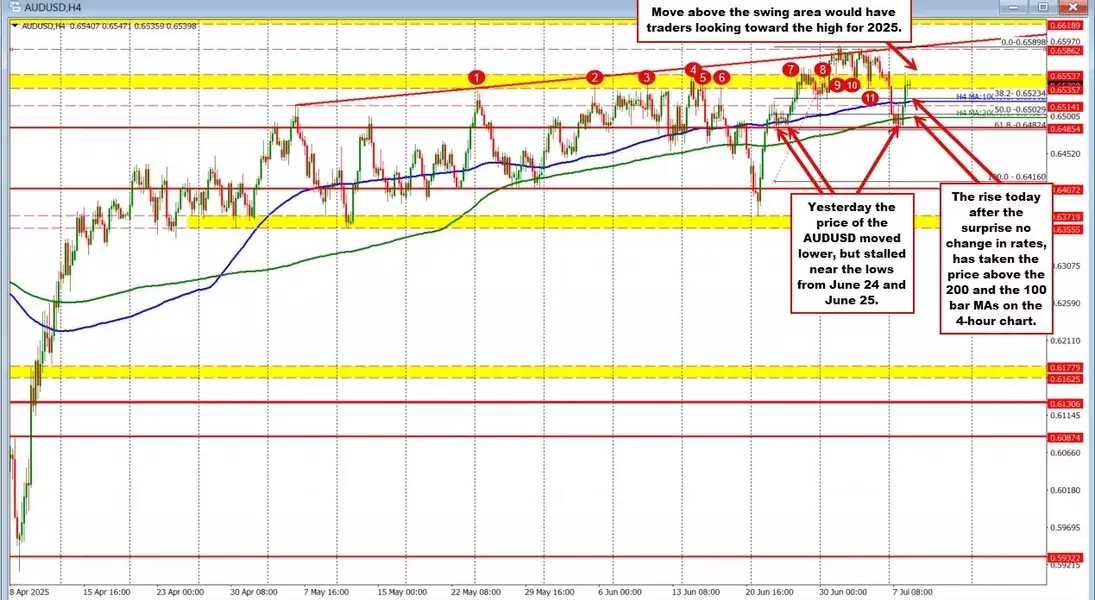
The U.S. dollar's activity at the start of the North American session reveals a complex interplay of forces. It showed a depreciation against the Euro, Japanese Yen, and British Pound, reflecting diverse market reactions to prevailing economic indicators and policy expectations. Conversely, the dollar gained ground against the Australian dollar. This specific movement was largely attributable to the RBA's recent interest rate announcement. On July 8, the RBA maintained its cash rate at 3.85%, defying market consensus that anticipated a 25 basis point cut. This decision was rooted in the bank's desire for additional data to confirm that inflation is consistently moving towards its 2.5% target, despite inflation having eased to 2.1% in May—its lowest point since October 2024.
Michele Bullock, the Governor of the RBA, underscored the central bank's preference for a measured and gradual approach to any future rate reductions. She noted that while market interpretations of recent inflation figures varied, the RBA prioritizes awaiting more comprehensive data, particularly the upcoming quarterly Consumer Price Index (CPI) report scheduled for July 30. Bullock clarified that monthly inflation figures exhibit too much volatility for definitive policy actions, and the central bank requires firm confirmation of sustained disinflation before adjusting rates. She also addressed earlier market speculation regarding a larger 50 basis point cut in May, stating it was merely an option briefly considered and quickly set aside in favor of a more conservative 25 basis point adjustment. Furthermore, internal policy discussions within the RBA reportedly showed only minor disagreements, primarily concerning the timing of rate changes rather than their overall direction, with international risks also factoring into the cautious stance. Ultimately, Bullock reaffirmed that the current pause in rate adjustments does not signify an indefinite holding pattern but rather a strategic decision to proceed with caution until robust data supports a rate cut. Despite the RBA's rationale, Treasurer Jim Chalmers expressed disappointment, highlighting the government's ongoing efforts to alleviate cost-of-living pressures for citizens.
Following the RBA's decision, the AUDUSD currency pair experienced a significant uptick, rising by 0.83%, effectively reversing much of the previous day's losses. The pair ascended above its 200 and 100-bar moving averages on the 4-hour chart, reaching a crucial resistance zone between 0.65357 and 0.65537. A sustained move beyond this level could potentially see the pair challenge last week's and the year's highs around 0.6590. Simultaneously, the global trade landscape is bracing for new challenges. On Monday, former President Trump signaled a potential return to elevated tariffs, issuing warning letters to 14 nations, including major economies like Japan and South Korea. These warnings indicate that higher duties, surpassing the current 10% baseline, are set to take effect on August 1. While Trump described the deadline as "firm, but not 100% firm," suggesting room for negotiation, the reintroduction of these tariffs excludes previously announced sector-specific levies. The absence of India and the European Union from these initial warnings has led to speculation about possible impending trade agreements. Both Japan and South Korea have expressed readiness to negotiate, seeking exemptions or adjustments to the proposed tariffs. China, meanwhile, issued its own cautionary statement to Trump, advising against reigniting their trade dispute and emphasizing the fragile nature of a recent trade truce established in June, the specifics of which remain undisclosed. China now faces an August 12 deadline to finalize a trade deal to avert the reinstatement of potentially severe tariffs, which could exceed 100%.
The broader U.S. stock market displays a mixed performance following recent declines. The Dow Industrial Average shows a downturn, while the S&P and NASDAQ indices are generally stable. This follows a week where both the S&P and NASDAQ achieved record closing levels last Thursday. In the bond markets, U.S. debt yields have edged higher across the spectrum, reflecting growing investor caution. Commodity markets also show varied movements: crude oil slightly decreased, gold experienced a notable drop, and Bitcoin saw an increase, nearing its previous all-time high. The economic calendar for the day remains light, with the release of the Canada Ivey Purchasing Managers Index for June being the primary data point.