Navigating the Global Market's Unexpected Surges and Setbacks
Unveiling the Unexpected: A Year of Global Investment Surprises
Top Performers in the Global Stock Arena: Who Led the Charge?
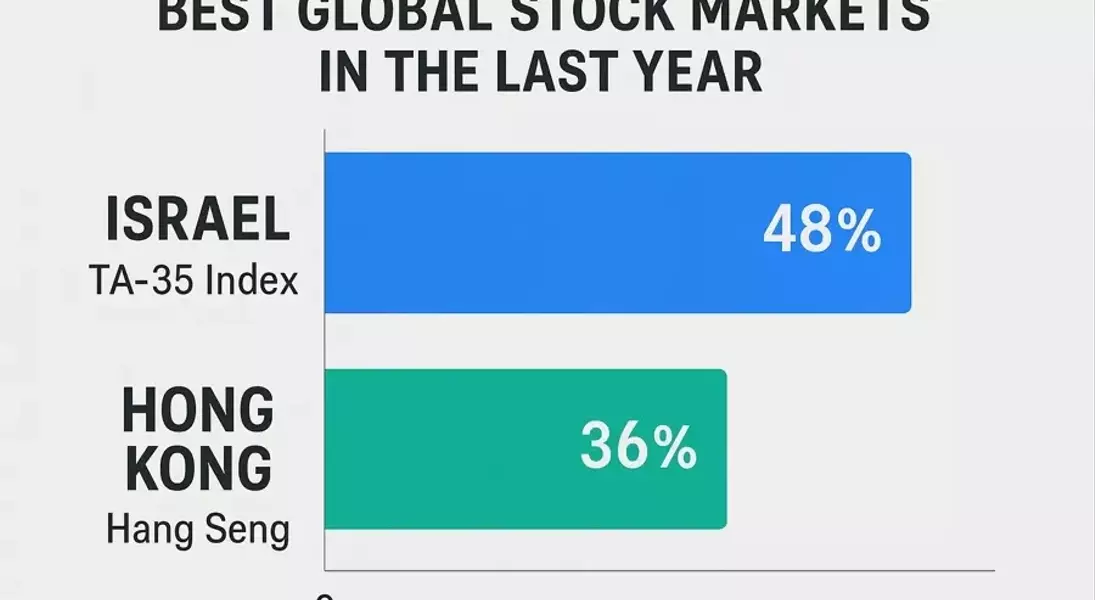
In the recent investment cycle, several stock markets defied expectations with impressive growth. Israel's TA-35 Index soared by 48.31%, propelled by robust domestic economic expansion and a surge in investor confidence. Hong Kong's Hang Seng index climbed 36.11%, benefiting from China's renewed economic activity and supportive governmental measures. Germany's DAX also posted significant gains, rising by 30.48%, reflecting strong industrial output and economic stability within Europe's largest economy. Furthermore, the South African Top 40 index saw a healthy increase of 21.13%, buoyed by a rebound in commodity prices and a more optimistic economic outlook.
The Underdogs: Markets That Faced Headwinds and Declines
While some markets flourished, others struggled to maintain momentum. Japan's Nikkei 225 experienced a decline of 3.84%, hampered by a sluggish economic recovery and subdued domestic demand. Saudi Arabia's TASI index dropped by 2.80%, primarily due to fluctuating oil prices and rising geopolitical tensions in the region. France's CAC 40 remained largely stagnant, with a minimal gain of 0.04%, indicative of challenges in industrial production and political uncertainties.
Currency Market Shifts: A Look at the Euro and Japanese Yen
The currency landscape saw notable movements. The Euro strengthened against the U.S. dollar by 8.73%, influenced by shifts in monetary policy, a weakening dollar, and better-than-anticipated economic data from Europe. Concurrently, the Japanese Yen appreciated by 9.09% against the U.S. dollar, as it became a preferred safe-haven asset amidst global instability and positive adjustments in its monetary policy.
Commodity Conundrum: Gold's Ascent and Oil's Descent
In the commodities sector, gold surged by 39.63%, driven by escalating geopolitical risks, inflation concerns, and a heightened investor appetite for safe-haven assets. Conversely, West Texas Intermediate (WTI) crude oil prices fell by 18.80%, impacted by fears of a global economic slowdown, abundant supply, and lower-than-expected demand.
Cryptocurrency Spotlight: Bitcoin's Dominance and Ethereum's Challenges
Among cryptocurrencies, Bitcoin was the undisputed leader, growing by an astounding 93.22%. This remarkable performance was fueled by increasing institutional adoption, enhanced regulatory clarity, and its growing acceptance in mainstream finance, even amid broader market volatility. Ethereum, however, saw an annual decrease of 13.49%, struggling with regulatory ambiguities and stiff competition from rival platforms, despite a recent strong rebound driven by optimism for upcoming network enhancements.
Tech Titans: NVIDIA's Surge and Tesla's Mixed Fortunes
Major U.S. technology stocks presented a varied picture. NVIDIA's stock climbed 24.23%, benefiting from explosive demand in artificial intelligence and robust growth in the semiconductor industry. Tesla, while up 17.67% over the year, faced a year-to-date decline of 24.65%, reflecting concerns over its profitability and intensified competition in the electric vehicle market.
Understanding Volatility in U.S. Treasury Yields
U.S. Treasury yields experienced modest annual growth of 1.84% but declined by 4.11% year-to-date. This volatility signals investor uncertainty regarding future Federal Reserve interest rate policies, inflation projections, and the broader economic outlook.
Strategic Implications for Global Investors: Navigating the New Normal
The past year's market trends offer crucial lessons for global investors. The robust performance of equity markets in Israel, Germany, and Hong Kong suggests these regions may offer continued growth opportunities. Gold's strength reinforces the value of including traditional safe-haven assets in a diversified portfolio. Bitcoin's resilience positions it as a viable option for diversification in a volatile market. Conversely, the downturn in oil prices and Treasury volatility highlight potential risks in growth-sensitive assets, urging caution amidst global economic uncertainties.
Regional Market Dynamics: Deeper Insights into Performance Drivers
Israel's market growth was underpinned by its economic vitality, innovation, and strong investor confidence. Hong Kong thrived due to China's economic resurgence and supportive government policies. Germany's market benefited from solid industrial and export growth, coupled with stable economic fundamentals. South Africa's market gained from rising commodity prices and improved economic sentiment. Japan's stock market struggled with a slow economic recovery and weak domestic demand. Saudi Arabia's performance was heavily impacted by oil price fluctuations and regional geopolitical tensions. France experienced minimal growth, reflecting industrial challenges and political uncertainties.
Investor Takeaway: Embracing Diversification in an Unpredictable World
The past year unequivocally demonstrated the unpredictability of global markets. No one could have foreseen Israel's stock market emerging as a leading global performer, second only to Bitcoin. As financial landscapes continue to evolve, investors are encouraged to embrace strategic diversification across various regions and asset classes. This involves balancing high-growth potential assets like Bitcoin and select equities with stable safe-haven investments such as gold, particularly in the face of ongoing global uncertainties. A thorough assessment of regional economic conditions, shifts in monetary policy, and geopolitical risks is essential to enhance portfolio resilience and performance.