Navitas Semiconductor: Charting a Course Through Volatile Markets and Strategic Partnerships
Navigating the Currents: Navitas's Journey from IPO to Nvidia Partnership
The Rise of GaN and SiC: A New Era in Semiconductor Technology
Navitas Semiconductor has emerged as a leader in the development of power chips, utilizing cutting-edge gallium nitride (GaN) and silicon carbide (SiC) technologies. These advanced materials offer superior efficiency compared to conventional silicon-based semiconductors, enabling devices to consume less energy and occupy a smaller footprint. This technological advantage positions Navitas at the forefront of the evolving power electronics landscape.

A Bumpy Ride Since Inception: Initial Public Offering and Market Performance
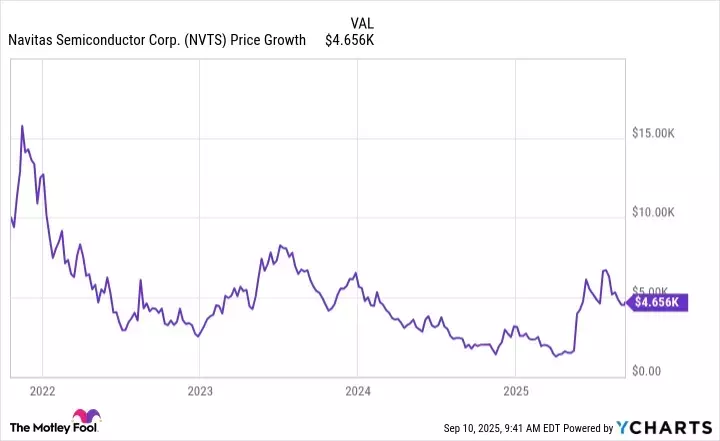
Despite the promise of its innovative technology, Navitas's stock performance has been turbulent since its special purpose acquisition company (SPAC) IPO in October 2021. An initial investment of $10,000 at the time of the merger would have significantly decreased in value. The company's market entry coincided with the peak of the 2021 bull market, leading to a substantial downturn in 2022. The stock reached its lowest point in May of the current year.
The Nvidia Catalyst: A Strategic Alliance for Data Center Infrastructure
A turning point for Navitas arrived with the announcement of a partnership with Nvidia. This collaboration, set to commence in 2027, will see Navitas contributing to Nvidia's Kyber data center infrastructure. Kyber represents a new architectural paradigm designed to support server racks for Nvidia's forthcoming Vera Rubin chip. This strategic alliance has since sparked a significant rebound in Navitas's stock value, with shares experiencing a notable surge.
Financial Outlook and Investor Considerations: Dilution and Revenue Challenges
While the Nvidia partnership offers a glimmer of hope, Navitas's financial performance continues to present challenges. The company recently issued over 21 million additional shares, increasing its outstanding share count by 11%. Furthermore, recent revenue figures indicate a downward trend, with the second quarter of 2025 experiencing a 29% decline from the previous year. Forecasts for the third quarter suggest a continued sequential decrease in revenue. Given these factors, while a full recovery or positive returns are possible for long-term investors, Navitas remains a high-risk, speculative investment due to ongoing uncertainties and share dilution.